Money can essentially be studied in two forms, these are the limited (solid) form and the unlimited form. Limited money is the metals with intrinsic value such as gold, silver, platinum, which cannot be produced in the desired amount by the states, whose amount is limited in the world. Recently, digital currencies have been tried to be added to these.…
GREAT TRANSFORMATION FROM MONETARY ECONOMY TO INFORMATION ECONOMY
GREAT TRANSFORMATION FROM MONETARY ECONOMY TO INFORMATION ECONOMY The economic system we have been in for nearly 300 years since the Industrial Revolution is a monetary system. Firstly, European countries, USA; The money economy, which developed with the industrial revolution in developed countries such as Japan, turned towards digitalization with the production of microchips in the 1950s. Today, the common…
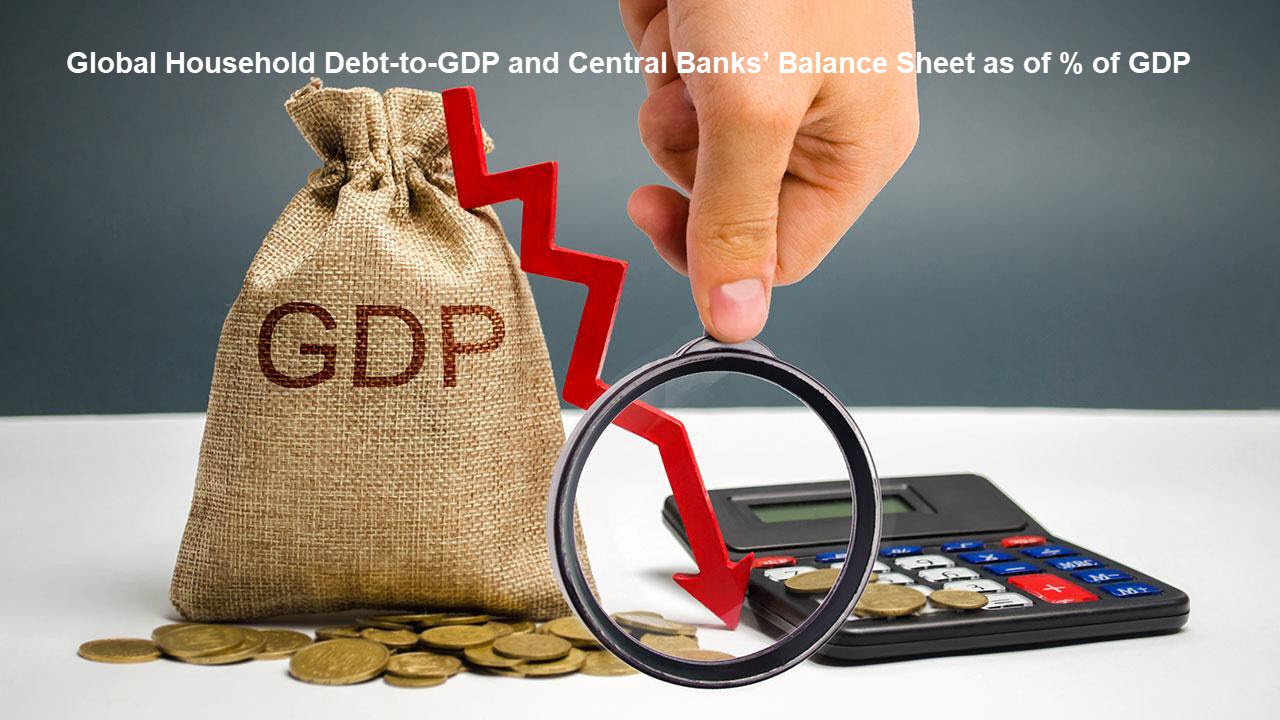
Global Household Debt-to-GDP and Central Banks’ Balance Sheet as of % of GDP
The ratio of the total household debt to production, which includes the debt of the private sector and households on a country basis as well as the debt of the states in the world, is another important indicator that can give an idea about the magnitude of the destruction to be experienced in the crisis.
Global Government Debts-to-GDP Ratio
In the monetary system of the world, the ballooning created by the unlimitedly printed money in the markets is the most important factor triggering the systemic crisis. Here, the question arises of how countries will be affected by the impending global financial disaster.
REAL ESTATE MARKET ON THE WAY TO CRISIS
Another important indicator of the global crisis is the ballooning in the real estate market as a result of excessive pricing. It is necessary to briefly summarize the situations in which there is a problem in the real estate market and many of them will show the risk of collapse in the market if they happen. We can summarize these…
10-Year US Bond Rates and US Real GDP Growth Rates
In Figure 1, we can see the 10-year bond interest rates and real GDP growth rates of the USA. If we look at the crisis years mentioned earlier, we see that the Real GDP growth rate was lower than the 10-year bond rate, especially in the 2001 crisis.
LIBOR
LIBOR interest rates have been on the rise since 2015. As can be seen in Figure, this interest rate rises significantly before every crisis. It rose to 2.4 percent in 2019, which is not seen in the graph, and has started to decline since that year. As of September 2020, this ratio is around 0.82 percent (www.global-rates.com). The crisis comes…
Central Bank Digital Currency
The monetary system is changing as a natural target of technological development. The time to say goodbye to fiat papers and coins is near. In this new financial system, when the economy starts to shift to digital environments, money cannot be expected to remain in its old form. In addition, we know that in the old system, the intermediary financial…