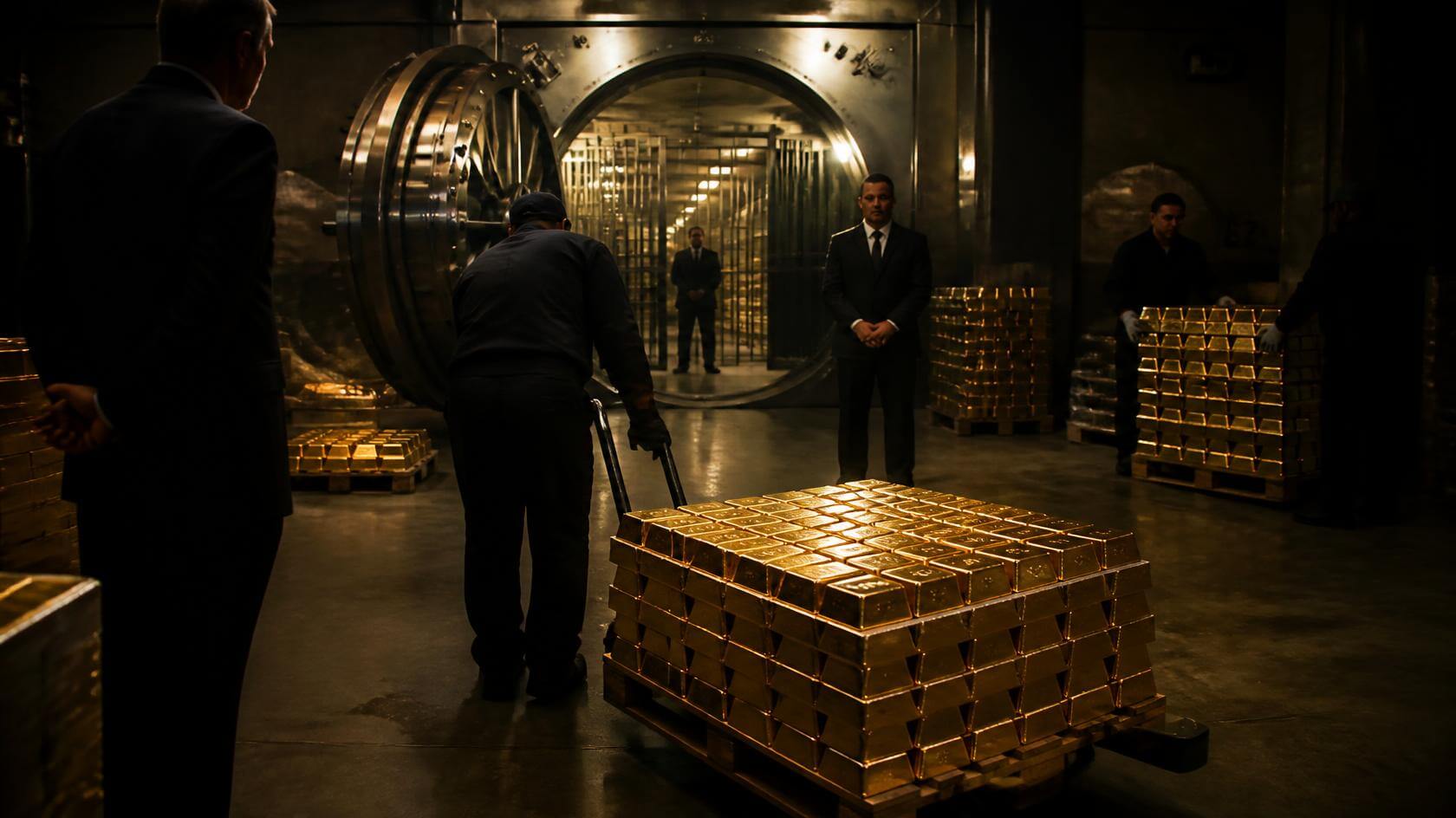
Something is happening behind closed doors that almost nobody is talking about. The world’s central banks—the institutions that manage the money supply of entire nations—are quietly doing something they have never done before at this scale. They are moving gold. Not just buying it. Moving it. Bringing it home. Locking it in their own vaults. And they are doing it faster than ever.
In June 2026, the World Gold Council published its annual survey of central bank reserve managers. The numbers tell a story that should make every person who holds a bank account, a retirement fund, or a mortgage pay attention. For the first time in the survey’s nine-year history, 45% of central banks said they plan to increase their gold holdings over the next twelve months. That is a record. Not 20%. Not 30%. Forty-five percent.
But that is not the most important number. Here is what matters more: 9% of central banks moved gold back to their home countries in the last year. Another 10% shifted where they store their gold overseas. They are not just buying gold. They are taking physical control of it. They are bringing it closer. They are preparing for something.
When a central bank moves billions of dollars worth of gold bars across oceans and borders, it is not making a routine investment decision. It is making a statement about trust. And right now, that statement is clear: we do not trust the old system anymore.
The Numbers That Tell the Real Story
Let me show you exactly what the data says. The World Gold Council surveyed 76 central banks between February and May 2026. These are the people who decide whether your country’s currency stays strong or collapses. These are the institutions that hold trillions of dollars in reserves to protect their nations during crises. And here is what they told the surveyors:
The Trust Breakdown
- 89% expect global gold reserves to increase this year
- 74% believe the U.S. dollar’s share of global reserves will decline over the next five years
- 84% think gold will represent a larger share of their own reserves in five years
- 90% said they hold gold because of how it performs during financial or political crises
Look at that 74% figure again. Three out of four central bank managers—the professionals who manage the world’s reserve assets—expect the dollar to lose ground. These are not conspiracy theorists on the internet. These are the people sitting in the actual vaults counting the actual money.
And they are acting on it. Over the past four years, central banks bought an average of 1,000 tonnes of gold every year. That is double the rate they bought during the previous decade. Poland alone added 64 tonnes in the first half of 2026, bringing its total to 614 tonnes with a public target of 700 tonnes. China bought gold for twenty straight months through May 2026, reaching 2,331 tonnes in official reserves.
The Repatriation Wave: Bringing Gold Home
But buying gold is one thing. Moving it is another. And that is where the story gets interesting.
Germany started this trend back in 2013. The Bundesbank announced it would move 674 tonnes of gold—worth tens of billions of dollars—from vaults in New York and Paris back to Frankfurt. The stated reason was simple: German citizens wanted to know their gold was actually there, on German soil, ready to be used if a crisis hit. They finished that move in 2017, three years ahead of schedule.
The Netherlands did the same thing quietly in 2014, moving 122.5 tonnes from New York to Amsterdam without announcing it beforehand. France completed its full repatriation in 2026. India brought home over 100 tonnes during the 2024-2025 financial year. Serbia repatriated 100% of its gold in 2025.
Why does this matter? Because when you store your gold in someone else’s vault—even if that vault is in New York or London—you are trusting that you can get it back when you need it. And that trust is breaking.
In 2022, when Russia invaded Ukraine, Western nations froze approximately $300 billion of Russian central bank reserves. Most of that money was sitting in European banks, mostly at a Belgian clearing house called Euroclear. Russia could not touch it. The gold Russia held inside its own borders could not be frozen, but it also could not be sold on international markets because Russian refiners were kicked off the approved lists.
Every central bank in the world watched that happen. And they learned a lesson: if your reserves are stored in someone else’s country, they can be locked or seized if politics turn against you.
That is why 9% of central banks moved gold to domestic storage in the last year. That is why 10% diversified where they keep their gold overseas. They are not making these moves because of investment returns. Gold pays no interest. They are making these moves because of fear. Fear that their reserves could be frozen. Fear that access could be denied. Fear that when the crisis comes, the vault door will be locked from the outside.
The China Signal: When Paper Gold Stopped Being Acceptable
On July 24, 2026, something else happened. Major Chinese banks—including the Industrial and Commercial Bank of China and China Construction Bank—stopped allowing retail customers to trade certain gold contracts linked to the Shanghai Gold Exchange.
Let me be clear about what this was and what it was not. This was not a ban on owning gold. Chinese people can still buy physical gold bars, gold coins, gold ETFs, and gold mutual funds. Corporate clients can still trade gold contracts. What stopped was retail access to leveraged paper gold products—contracts where you could borrow money to bet on gold prices without ever taking physical delivery.
The banks said this was about protecting retail investors from getting wiped out by margin calls during price swings. That explanation is partly true. But it also sends a signal. China is pushing its own citizens away from paper gold and toward physical gold. It is de-leveraging the system. It is saying: if you want gold exposure, own the actual metal or own shares in funds that hold the actual metal. Stop trading paper contracts that are fifty times removed from any real gold bar.
Some market analysts called this a “massive turning point.” They are right. Because the whole Western gold market is built on paper. For every ounce of physical gold that actually exists in a vault, there are multiple claims on that same ounce through futures contracts, allocated accounts, and derivatives. The system works as long as everyone trusts that the paper represents real metal. But if that trust breaks—if too many people demand physical delivery at the same time—the system seizes up.
China just told its citizens: we do not want you playing that game anymore.
What Gold Really Means in a Monetary System
Let me explain why this matters in the simplest terms possible.
There are two kinds of assets in the world. Productive assets make things or provide services. A factory is a productive asset. A farm is a productive asset. A company that builds software is a productive asset. You invest in productive assets because you expect them to generate wealth over time.
Then there are trust assets. Gold is the ultimate trust asset. It does not produce anything. It does not pay dividends. It does not grow crops. It just sits there. But it has one property that nothing else has: it cannot be printed, it cannot be created out of thin air, and it cannot be erased by a government decree.
When trust in governments is high, gold loses appeal. Why hold a metal that pays no interest when you can hold government bonds that pay 3% or 4%? But when trust in governments breaks, gold reprices overnight. And central banks know this.
That is why 90% of them cited “crisis performance” as their top reason for holding gold. They are not buying gold because they think it will go up 10% next year. They are buying gold because they think the system might break. And if it does, gold will be the only reserve asset that still has value when the dust settles.
Right now, gold has overtaken U.S. Treasury bonds as the world’s largest reserve asset by total value. Let that sink in. For decades, U.S. government debt was considered the safest, most liquid asset on Earth. Every central bank held Treasuries. Now, central banks are saying: we would rather hold gold.
The De-Dollarization Reality
This connects directly to what I have written about before on this website: the death of the petrodollar system (arzualvan.com). The global monetary architecture built after World War II was anchored on the U.S. dollar. Oil was priced in dollars. Trade was settled in dollars. Central banks held dollars as their primary reserve. That system gave the United States extraordinary power. It could print dollars, and the rest of the world had to accept them because they needed dollars to buy oil and settle trade.
That system is ending. Not because of ideology. Because of reality.
When the BRICS nations talk about trading in their own currencies, they are not launching some unified gold-backed “BRICS currency.” That idea has been reported in various places, but it is not verified by official statements. What is actually happening is simpler and more practical: countries are settling bilateral trade in their own national currencies—Chinese yuan, Indian rupees, Russian rubles—instead of converting everything to dollars first. They are linking their digital payment systems so transactions can bypass the dollar-based banking network. The New Development Bank is issuing bonds in local currencies to fund infrastructure projects.
None of this requires a new currency. It just requires a decision: we will stop using your currency as the middleman.
And when 74% of central bank reserve managers say they expect the dollar’s share of global reserves to decline over the next five years, they are telling you that decision has already been made. The only question now is how fast it happens.
The Russian Lesson: What Happens When the Vault is Locked
Russia learned this lesson the hard way. When Western nations froze $300 billion of Russian reserves in 2022, Russia discovered that the gold it held inside its own vaults was the only reserve asset it could actually use. It could not sell that gold on international markets because it was cut off from the global clearing system. But it could sell it domestically to Russian banks and convert the proceeds into yuan or other currencies to support the ruble.
And that is exactly what Russia did. In the first half of 2026 alone, Russia sold about 44 tonnes of gold from its National Welfare Fund. That is more than 50% of what it had left in that fund. Russia is burning through its gold reserves to keep its budget functioning while cut off from the dollar system.
Every other central bank watched this happen. And they drew the obvious conclusion: if you do not physically control your reserves, you do not actually own them when it matters most.
The Chart That Should Scare You
Let me show you a simple data table that captures everything I just explained:
| Survey Question | % of Central Banks |
| Plan to increase gold holdings in next 12 months | 45% |
| Expect global gold reserves to increase | 89% |
| Expect US dollar share of reserves to decline | 74% |
| Expect gold share of reserves to increase | 84% |
| Hold gold for crisis performance | 90% |
| Increased domestic storage in last 12 months | 9% |
| Diversified overseas storage in last 12 months | 10% |
This is not one indicator. This is a consensus. A consensus among the people who manage the world’s reserve assets. And the consensus is: the system as we know it is changing, and gold is the safe harbor.
Who Is Moving Gold and Where
Here is a breakdown of which countries are moving the most gold right now:
Top Accumulators (First Half 2026)
- Poland: +64 tonnes (target: 700 tonnes total)
- China: +10 tonnes in May alone (20 months straight of buying)
- Uzbekistan: +33 tonnes (gold now represents 87% of its total reserves)
- Kazakhstan: +20 tonnes
- Chile, Guatemala, Bolivia, Uruguay: All added gold for the first time or significantly increased holdings
Recent Repatriations
- India: Over 100 tonnes brought home in FY 2024-2025
- Serbia: 100% of gold repatriated in 2025
- France: Completed full repatriation in 2026
- Germany: 674 tonnes moved from New York and Paris to Frankfurt (completed 2017)
- Netherlands: 122.5 tonnes moved from New York to Amsterdam (2014)
These are not random moves. These are coordinated strategies. Smaller nations are buying gold to reduce their dependence on the dollar. Larger nations are bringing gold home to ensure they control it. And everyone is watching Russia’s frozen reserves as a warning of what can happen if you trust the wrong vault.
What This Means for You
If you are reading this and thinking, “This is interesting but does not affect me,” let me explain why you are wrong.
When central banks lose faith in paper currencies and start hoarding gold, they are telling you that they expect inflation, currency crises, or financial instability. They do not repatriate gold because they think everything will be fine. They repatriate gold because they are preparing for a scenario where it is not fine.
If you hold your savings in a bank account, you are holding paper currency. If that currency loses value because the central bank prints too much of it, or because trust in the government collapses, your savings lose value. You cannot stop that from happening. But you can understand what the professionals are doing and make your own decisions accordingly.
The central banks are not buying stocks. They are not buying real estate. They are not buying corporate bonds. They are buying gold and moving it to their own vaults. That is the signal.
The Breaking Point
We are at a breaking point. Not because of one event. But because of accumulated pressure. The U.S. national debt is over $30 trillion. The Federal Reserve has printed trillions of dollars since 2008. The dollar-based system has been weaponized through sanctions, which made every other country realize that holding dollars is a political risk, not just an economic one. And now, for the first time, central banks are publicly saying through their actions: we are preparing for a world where the dollar is no longer the anchor.
The 45% threshold is not just a statistic. It is a tipping point. It is the moment when institutional behavior shifts from hedging to preparation. When nearly half of the world’s monetary authorities are planning to increase their gold holdings at the same time, while simultaneously moving that gold closer to home, they are not making an investment bet. They are building a lifeboat.
And the most important question you should ask yourself is this: if the people who manage trillions of dollars in reserves are building lifeboats, should you be paying attention?
Data Appendix
Chart 1: Central Bank Gold Accumulation Trend (2010-2026)
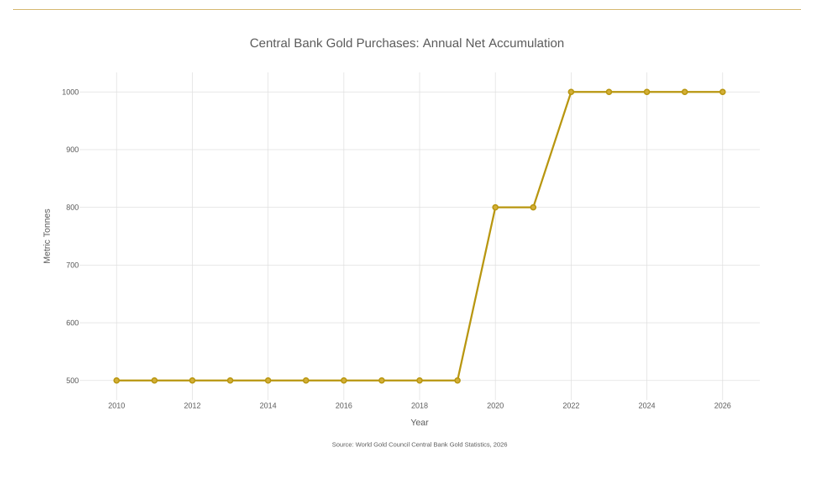
Chart 1: Central Bank Gold Accumulation Trend (2010-2026) Description: Line chart showing annual net central bank gold purchases in metric tonnes Data Series: • 2010-2019 average: ~500 tonnes per year • 2020-2021: ~800 tonnes per year • 2022-2026 average: ~1,000 tonnes per year Source: World Gold Council Central Bank Gold Statistics, 2026 |
Chart 2: Central Bank Reserve Asset Preferences (5-Year Outlook)
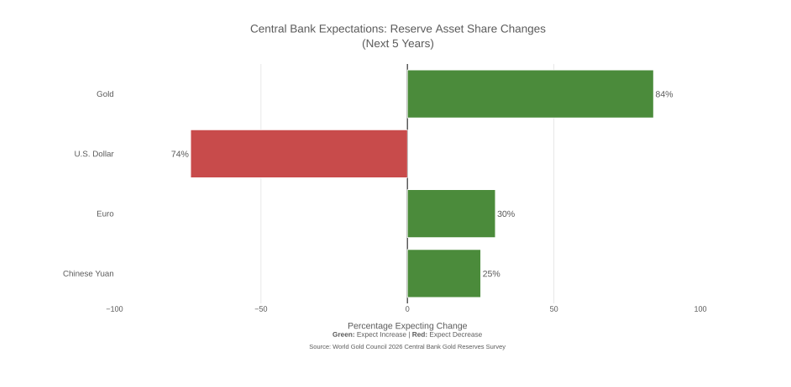
Chart 2: Central Bank Reserve Asset Preferences (5-Year Outlook) Description: Horizontal bar chart showing percentage of central banks expecting each reserve asset category to increase or decrease as share of total reserves over next 5 years Data Series: • Gold (expect increase): 84% • U.S. Dollar (expect decrease): 74% • Euro (neutral to slight increase): ~30% • Chinese Yuan (expect increase): ~25% Source: World Gold Council 2026 Central Bank Gold Reserves Survey |
Chart 3: Geographic Distribution of Gold Repatriation Activity (2013-2026)
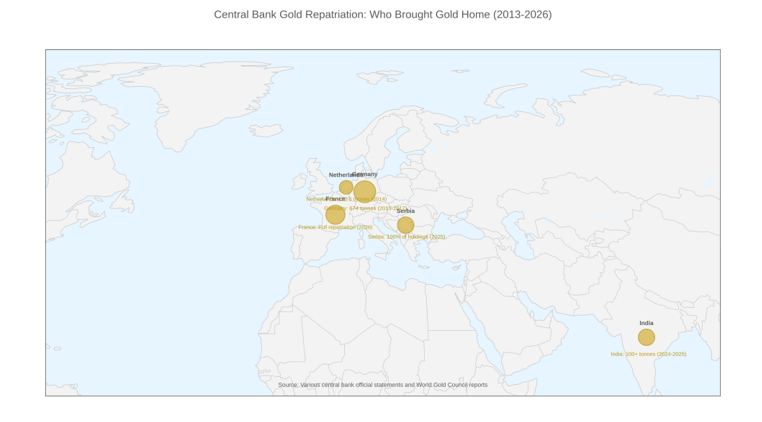
Chart 3: Geographic Distribution of Gold Repatriation Activity (2013-2026) Description: World map with highlighted countries and total tonnes repatriated Data Series: • Germany: 674 tonnes (2013-2017) • Netherlands: 122.5 tonnes (2014) • India: 100+ tonnes (2024-2025) • Serbia: 100% of holdings (2025) • France: Full repatriation (2026) Source: Various central bank official statements and World Gold Council reports |
Glossary
Central Bank — Think of this as the main bank of a country. It is not where you have your personal account. It is the bank that controls how much money exists in the country and manages the country’s savings (called reserves). The U.S. has the Federal Reserve. Europe has the European Central Bank. Every country has one.
Foreign Exchange Reserves — This is the savings account of a country. Just like you might save money for emergencies, countries save foreign currencies, gold, and bonds. They use these reserves to protect their currency if it gets too weak or to pay for imports if they run short on cash.
Gold Reserves — The physical gold bars that a country owns and stores in vaults. Countries hold gold because it keeps its value even when paper money loses value. It is like having a savings account that cannot be printed or erased by anyone.
Repatriation — This means bringing something back home. When a country repatriates gold, it means moving gold bars from a vault in another country back to a vault in its own country. Germany repatriated 674 tonnes of gold from New York and Paris back to Frankfurt.
Metric Tonne — A unit of weight equal to 1,000 kilograms or about 2,204 pounds. One tonne of gold is worth tens of millions of dollars depending on the current price.
De-Dollarization — The process of reducing reliance on the U.S. dollar for international trade and reserves. Instead of using dollars as the middleman for every transaction, countries trade using their own currencies or alternatives like the Chinese yuan.
Paper Gold vs. Physical Gold — Physical gold means you own actual gold bars or coins you can touch. Paper gold means you own a contract or certificate that represents gold, but you do not physically hold it. Paper gold can be sold by banks many times over, but physical gold exists only once.
Leveraged Trading — Borrowing money to make bigger bets on price movements. If you have $1,000 and you borrow $9,000 more, you can trade as if you have $10,000. If the price goes up, you make ten times more profit. But if it goes down, you lose everything very quickly. This is why it is risky, especially for regular people.
Petrodollar System — The arrangement where oil-producing countries agreed to sell oil only in U.S. dollars. This created global demand for dollars and gave the U.S. immense financial power. This system is breaking down as countries start selling oil in other currencies like Chinese yuan.
BRICS — A group of major emerging economies: Brazil, Russia, India, China, and South Africa. Recently expanded to include more nations. They are working together to reduce dependence on the U.S. dollar and Western financial institutions.
Sovereign Debt — Money that a government owes. When a government spends more than it collects in taxes, it borrows money by issuing bonds. The U.S. national debt is over $30 trillion, meaning the U.S. government owes that much to bondholders around the world.
Inflation — When the prices of things you buy go up over time, and your money buys less than it used to. If bread cost $2 last year and $3 this year, that is inflation. It happens when too much money is printed or when people lose trust in a currency.
OTC Market (Over-the-Counter) — A way of trading that happens privately between two parties instead of on a public exchange. Most central bank gold buying happens in the OTC market, where large deals are done directly with gold dealers and banks, not on public gold exchanges.
Sources and References
- World Gold Council, 2026 Central Bank Gold Reserves Survey, June 16, 2026
- World Gold Council, Central Bank Gold Statistics, July 2026
- Reuters News Service, multiple reports on BRICS currency discussions and policy, 2023-2026
- S. Congressional Research Service, Russia’s Frozen Central Bank Assets, Report IF12062
- Industrial and Commercial Bank of China (ICBC), Customer Compliance Notices, June 2026
- China Construction Bank (CCB), Customer Compliance Notices, June 2026
- Deutsche Bundesbank official statements on gold repatriation, 2013-2017
- De Nederlandsche Bank (DNB) official statements on gold storage strategy, 2014
- National Bank of Poland press releases and official reserve data, 2026
- People’s Bank of China monthly gold reserve updates, 2024-2026
- Reserve Bank of India annual reports and repatriation statements, 2024-2025
- Bank of Korea official statements on gold reserve strategy, 2026
- Various financial news sources: Kitco News, Reuters, CNBC, Bloomberg (dates as cited in research notes)
Note to readers: This article is based on publicly available data from official central bank sources, World Gold Council surveys, and verified news reports as of August 2, 2026. All statistics and country-specific data have been cross-referenced with primary sources. Where claims could not be independently verified (such as certain BRICS currency proposals), they have been explicitly noted as unverified in the analysis.