The petrodollar is dying. Everyone can see it now. Saudi Arabia prices oil in yuan. Russia sells gas in rubles. India pays for Iranian crude in rupees. The dollar’s share of global reserves has fallen to 57%, down from over 70% two decades ago.
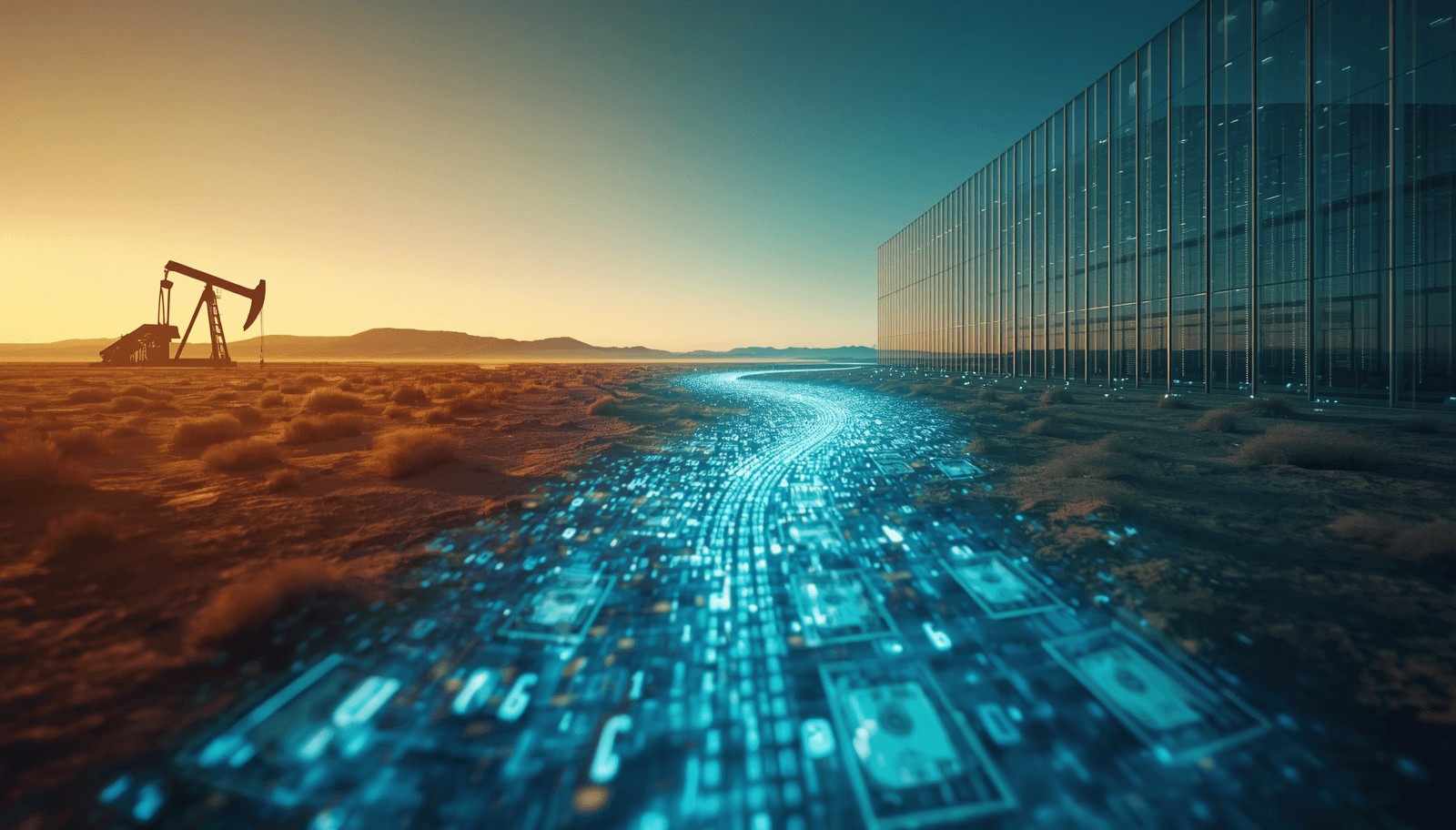
But something strange is happening. Just as one pillar of dollar demand crumbles, another is being built at astonishing speed. And this new pillar is not made of oil. It is made of ones and zeros.
In 2026, the world’s largest technology companies are borrowing $300 billion to build what they call “AI Factories”—massive data centers filled with chips that generate artificial intelligence. Amazon borrowed $100 billion. Alphabet raised $31.5 billion. Meta pulled in $25 billion. Oracle took $25 billion. Microsoft is expected to follow.
This is not normal. These companies are enormously profitable. They could fund this expansion from their cash flow. But they are choosing debt. Dollar-denominated debt. And the world is buying it.
Is this the new petrodollar? Has the anchor of American monetary power shifted from oil fields in the desert to server farms in Virginia? Or is this something more fragile—a desperate attempt to manufacture dollar demand as the old system collapses?
The Ghost of 1974
To understand what is happening now, you need to understand what happened fifty years ago.
In August 1971, President Richard Nixon ended the convertibility of dollars into gold. The Bretton Woods system—where every dollar was backed by $35 worth of gold—died overnight. Suddenly, the dollar was just paper. A promise backed by nothing.
The world panicked. If the dollar was not tied to gold, why should anyone accept it?
The answer came in 1974. After the oil crisis of 1973, the United States made a deal with Saudi Arabia. The Saudis would price all their oil in dollars. Every country that needed oil—which was every country—would need dollars to buy it. And the Saudis would take those dollars and buy U.S. Treasury bonds.
It was brilliant. The system created automatic, permanent demand for dollars. Oil was not optional. Every car, every factory, every power plant needed it. So every country needed dollars. And the surplus dollars flowed back into U.S. government debt, keeping American interest rates low.
This was the petrodollar system. It lasted fifty years. And now it is ending.
The AI Debt Machine
Fast forward to 2026. Amazon, Google, Microsoft, Meta, and Oracle are in the middle of the largest corporate borrowing binge in history. Between them, they are expected to issue between $250 billion and $300 billion in bonds this year alone. Global AI-related debt issuance—including other companies and financing vehicles—will reach $570 billion in 2026, according to Morgan Stanley.
Where is this money going? Into data centers. Enormous, power-hungry buildings filled with graphics processing units (GPUs) that train and run artificial intelligence systems. These companies are planning to spend over $700 billion on capital expenditures in 2026. About 75% of that is for AI infrastructure.
They are not borrowing short-term. Amazon issued bonds that mature in 40 years. Alphabet issued a 100-year bond in British pounds. Oracle sold bonds due in 2066. These are commitments that will outlive most of the people reading this article.
And almost all of it is denominated in U.S. dollars.
Here is what that means: global investors—pension funds, insurance companies, sovereign wealth funds—are pouring money into these bonds. To buy them, they need dollars. When the bonds mature, they will be paid back in dollars. When the companies pay interest every six months, they will pay in dollars.
This creates a river of dollar demand. It is not as visible as oil tankers crossing the ocean. But it is just as real.
The $300 Billion in Context
| Source of Dollar Demand | Mechanism | Annual Scale (Est.) | Nature |
| Petrodollar System (Peak Era, ~2000s) | Nations buy oil priced in dollars; exporters recycle surplus into U.S. Treasuries | ~$300-500B/year in oil trade + recycling | Sovereign necessity |
| AI Infrastructure Debt (2026) | Tech companies issue dollar bonds; global investors buy to fund data centers | ~$300B in corporate bonds (2026 YTD) | Corporate/investor choice |
| U.S. Treasury Market (2026) | U.S. government borrows to finance deficit | ~$1.5-2 trillion/year | Sovereign debt |
The numbers are comparable. The petrodollar system, at its height, generated a few hundred billion dollars per year in recycled demand. The AI debt boom is on the same scale. But the mechanics are completely different.
Oil vs. Compute: A Broken Analogy
The petrodollar system worked because oil is special.
First, oil is physical. You can see it, measure it, ship it in tankers. It is fungible—a barrel of crude from Saudi Arabia does the same thing as a barrel from Texas. Every modern economy needs it. There is no substitute.
Second, the petrodollar was a deal between governments. The U.S. promised to protect Saudi Arabia. Saudi Arabia promised to price oil in dollars and buy Treasury bonds. It was backed by military power and geopolitical alignment.
Third, it created a closed loop. Countries earned dollars by selling goods to America. They spent those dollars on oil from OPEC. OPEC invested the dollars back into U.S. government debt. The dollars never left the system.
Now compare that to AI infrastructure debt.
First, compute is not physical. It is not fungible. An AI model trained on Nvidia chips is not the same as one trained on Chinese Huawei chips. The services these data centers provide are not universal necessities. They are commercial products in a competitive market.
Second, this is not a government deal. It is a corporate financing decision. Amazon chooses to issue bonds. Investors choose to buy them. There is no security guarantee. There is no treaty. It is a market transaction, subject to market forces.
Third, there is no closed loop. Global investors lend dollars to tech companies. The companies build data centers. They sell AI services and pay back the bonds with interest. But the dollars do not automatically flow back into U.S. government debt. They flow to private bondholders.
The petrodollar created structural, sovereign-level dollar demand. The AI debt boom creates market-driven, corporate-level dollar demand. One was locked in by necessity. The other is locked in by investor appetite.
And investor appetite can change.
The Energy Shock No One Is Talking About
There is another problem. These AI data centers consume staggering amounts of electricity.
The International Energy Agency projects that global data center electricity use will double from 485 terawatt-hours in 2025 to 950 terawatt-hours by 2030. In the United States alone, data center power consumption could jump from 176 TWh in 2023 to 580 TWh by 2028.
To put that in perspective: a single large AI data center now uses as much power as 80,000 to 100,000 homes. The newest AI Factories being planned will consume multiple gigawatts. That is enough to power a small city. And they run 24 hours a day, 365 days a year.
This is causing real problems. In Northern Virginia—known as “Data Center Alley”—the regional grid operator, PJM, is facing such extreme demand growth that electricity prices in the capacity market spiked ninefold in recent auctions. In May 2026, the U.S. Department of Energy had to give PJM emergency authority to cut power to data centers to prevent rolling blackouts.
The Federal Reserve has noticed. In the June 2026 FOMC meeting minutes, officials explicitly stated that “strong demand for AI infrastructure is sustaining upward pressure on prices for both technology products and electricity.”
Here is the dark irony: the petrodollar system was built on energy. Oil was the commodity that anchored dollar demand. Now, the thing that is supposed to replace it—AI infrastructure—is consuming energy on a scale that is pushing up electricity prices and creating inflation.
The old system turned energy into dollar demand. The new system turns dollar-denominated debt into an energy crisis.
The Geopolitical Fracture
There is one more reason the AI debt boom cannot replicate the petrodollar system: the world is splitting in two.
The petrodollar worked because there was one global oil market, priced in one currency, controlled by one alliance (the U.S. and Saudi Arabia/OPEC). Everyone played by the same rules.
The AI market is fragmenting. The United States is blocking China from buying advanced chips. China is responding by building its own chips, its own data centers, and its own AI models. It is offering these systems to the Global South through initiatives like the Digital Silk Road, often financed in yuan or local currencies, not dollars.
China is betting on “inference”—the actual use of AI models—not “training.” Training requires the most advanced chips, which the U.S. controls. But inference can run on cheaper, less advanced hardware. And inference is where the real market is. China is positioning itself to dominate the mass market for AI services in Asia, Africa, and Latin America.
This means there will not be one global AI market priced in dollars. There will be at least two ecosystems: a U.S.-led, dollar-denominated, high-end system, and a China-led, local-currency, mass-market system.
The petrodollar was universal. The “computron-dollar” is contested.
What the Federal Reserve Sees
The Federal Reserve is watching this carefully. And they are worried.
In speeches throughout 2026, Fed officials have acknowledged that AI could eventually boost productivity and lower inflation. But that is the long term. In the short term, the AI boom is inflationary.
Fed Governor Lisa Cook called it an “unanticipated price shock” in May 2026. New York Fed President John Williams warned that if the cost pressures prove “persistent,” the Fed may have to raise interest rates instead of cutting them.
Think about what that means. The AI debt boom is supposed to support dollar demand. But if it causes inflation, the Fed has to tighten policy. Higher interest rates make U.S. debt more expensive. That could trigger a credit crunch. And if a credit crunch hits, the appetite for $300 billion in new corporate bonds could evaporate.
The Fed’s May 2026 Financial Stability Report listed AI-related corporate credit as a top risk. They are specifically worried about the long-term nature of the debt. Companies are borrowing money for 30, 40, even 100 years to buy technology that becomes obsolete in three to five years.
If AI does not generate the returns that investors expect, these companies will be left with massive debts and worthless hardware.
A Pillar Built on Sand?
So what is really happening here?
The petrodollar system is collapsing. That much is clear. The dollar’s role as the universal medium for energy transactions is ending. BRICS nations are settling 67% of their trade in local currencies. Central banks are buying gold at record levels. The old anchor is gone.
In its place, American technology companies are creating a new source of dollar demand by borrowing unprecedented amounts to build AI infrastructure. The scale is enormous. The appetite is real. Global capital is flowing into these bonds.
But it is not the same. The petrodollar was structural. The AI debt boom is cyclical. The petrodollar was locked in by geopolitics and necessity. The AI debt boom is driven by market sentiment and speculation.
And markets can turn.
If AI fails to deliver the productivity gains that justify the investment, this debt will become a burden. If energy costs keep rising, the business case will break. If the geopolitical competition leads to a bifurcated world, the universal dollar demand will fragment.
The petrodollar system took fifty years to collapse. How long will the “computron-dollar” system last?
Perhaps we are not witnessing the birth of a new monetary anchor. Perhaps we are witnessing the final, desperate phase of a debt-driven system that has run out of real anchors and is now borrowing against an imagined future.
The difference between oil and artificial intelligence is simple: oil powers the present. AI promises to power the future. The petrodollar was built on something people needed today. The AI debt boom is built on something people hope they will need tomorrow.
Hope is not a foundation. And debt is not an anchor.
Key Data Summary
AI Infrastructure Debt Issuance (2026 YTD): – Amazon: ~$100 billion – Alphabet: $31.5 billion – Meta: $25 billion – Oracle: $25 billion – Total projected tech sector: $250-300 billion – Global AI-related debt: $570 billion (Morgan Stanley estimate)
Energy Consumption: – Global data center electricity (2025): 485 TWh – Projected (2030): 950 TWh – U.S. data center electricity (2023): 176 TWh – Projected (2028): 580 TWh – Single large AI data center: equivalent to 80,000-100,000 homes
De-dollarization Indicators: – Dollar share of global reserves: 57% (2025), down from 70%+ (early 2000s) – BRICS intra-bloc trade in local currencies: 67% (2025)
Federal Reserve Position: – June 2026 FOMC: AI infrastructure “sustaining upward pressure” on tech and electricity prices – May 2026 Financial Stability Report: AI corporate credit listed as top risk
Glossary
AI (Artificial Intelligence): Computer systems designed to perform tasks that normally require human intelligence, such as understanding language, recognizing images, or making decisions. Think of it as teaching a machine to think and learn like a person.
Bond: A loan that investors make to a company or government. The borrower promises to pay back the money plus interest over time. It’s like an IOU that can be bought and sold.
BRICS: A group of major developing countries: Brazil, Russia, India, China, and South Africa. They are working together to reduce dependence on the U.S. dollar.
Capital Expenditure (Capex): Money a company spends to buy or build long-term assets like buildings, machines, or in this case, data centers. It’s different from money spent on day-to-day operations.
Central Bank: A country’s main bank that controls the money supply and interest rates. In the U.S., it’s the Federal Reserve. Think of it as the bank for all other banks.
Corporate Bond: A bond (loan) issued by a company, not a government. Investors buy these bonds to earn interest.
Credit Spread: The difference in interest rates between a corporate bond and a very safe government bond. A wider spread means investors think the company is riskier and demand more interest to compensate.
Data Center: A large building filled with powerful computers (servers) that store data and run internet services. AI data centers are specialized to train and operate artificial intelligence systems.
De-dollarization: The process of reducing reliance on the U.S. dollar for international trade and reserves. Countries are doing this by trading in their own currencies or using alternatives like the yuan or gold.
Debt Issuance: When a company or government borrows money by selling bonds. “Issuing debt” means creating and selling new loans to investors.
Federal Reserve (The Fed): The central bank of the United States. It controls interest rates and oversees the banking system to keep the economy stable.
FOMC (Federal Open Market Committee): The group within the Federal Reserve that decides U.S. interest rate policy. They meet regularly to assess the economy and make decisions.
Foreign Exchange Reserves: Assets (usually dollars, euros, gold) that a country’s central bank holds to back its own currency and pay for international transactions.
GDP (Gross Domestic Product): The total value of all goods and services produced in a country in a year. It’s the standard way to measure the size of an economy.
GPU (Graphics Processing Unit): A specialized computer chip originally designed for rendering graphics in video games. It turns out GPUs are also excellent at the math needed for artificial intelligence, so they are now the key hardware for AI systems.
Hyperscaler: A very large technology company that operates massive data centers and cloud computing services. Examples: Amazon, Google, Microsoft, Meta.
Inflation: When prices for goods and services go up over time, so your money buys less than it used to.
Interest Rate: The cost of borrowing money, expressed as a percentage. If you borrow $100 at 5% interest, you have to pay back $105.
Investor Appetite: How eager investors are to buy a particular asset. High appetite means lots of demand. Low appetite means weak demand and falling prices.
Petrodollar: The system where oil is priced and traded in U.S. dollars. Countries that buy oil need dollars, creating global demand for the dollar. Oil exporters then invest those dollars back into U.S. assets, especially Treasury bonds.
Recycling (Petrodollar Recycling): The process where oil-exporting countries take their dollar earnings from selling oil and invest them back into U.S. financial markets, especially U.S. Treasury bonds.
Treasury Bond (Treasury Security): A loan to the U.S. government. Considered one of the safest investments in the world because the U.S. has never defaulted on its debt.
Terawatt-Hour (TWh): A unit of energy. One terawatt-hour is enough electricity to power about 93,000 average U.S. homes for a year. It’s a way to measure the massive amount of electricity that data centers consume.
Yuan: The currency of China, also called the renminbi. China is trying to make the yuan a global alternative to the U.S. dollar.
Sources
- ABC News. “Massive AI Buildout Poses Latest Inflation Threat for Consumers.” 2026.
- Introl Blog. “Hyperscaler Capex $600B+ in 2026: AI Infrastructure Debt Surge.” January 2026.
- “Bond Investors Push Back as AI Debt Heads Toward $570 Billion.” July 17, 2026.
- “Global AI Debt Issuance to Top $500 Billion in 2026, Morgan Stanley Says.” June 10, 2026.
- International Energy Agency (IEA). “Energy and AI: Energy Demand from AI.” 2026.
- International Energy Agency (IEA). “Key Questions on Energy and AI: Executive Summary.” 2026.
- Institute for Energy Economics and Financial Analysis (IEEFA). “Projected Data Center Growth Spurs PJM Capacity Prices by Factor of 10.” 2026.
- Federal Reserve. “FOMC Minutes.” June 17, 2026.
- Federal Reserve. “Monetary Policy Report to Congress.” July 10, 2026.
- Los Angeles Times. “Massive AI Buildout Poses Latest Inflation Threat as Consumers Pay More for Laptops, Electricity.” July 13, 2026.
- Informed Clearly. “De-Dollarization: Dollar Reserve Share 2026.” 2026.
- P. Morgan. “De-dollarization: Currency Insights.” 2026.
- Think BRICS Substack. “The Dollar’s Slow Unraveling: How Bitcoin and BRICS Are Reshaping Finance.” 2026.
- Interesting Engineering Substack. “The Inference Revolution: How China’s AI Strategy Outflanks U.S. Chip Bans.” 2026.
- “BRICS Digital Sovereignty Fund Launched.” 2026.
- IDEAS BRICS. “Shared Code, Shared Progress: The China Open Source Initiative.” 2026.
- “Petrodollar Recycling.” Accessed 2026.
- MUFG Americas. “AI Chart Weekly: Financing the AI Supercycle.” December 19, 2025.
- net. “AI Debt Surge Hits $300 Billion as Hyperscalers Shock Bond Markets.” 2026.
- com. “AI Bond Issuance Tests the Market’s Appetite for Long-Dated Tech Debt.” 2026.
- PBS NewsHour. “Massive Data Center Buildout Poses Latest Inflation Threat for Consumers.” 2026.
- Yahoo Finance. “AI Hyperscalers Drive Higher US Corporate Debt Issuance.” 2026.
- KuCoin News. “Big Tech Firms Issue $159B in Bonds for AI Infrastructure in 2026.” 2026.
- Foley & Lardner. “Financing the Data Center Boom: Trends, Structures, and Considerations.” April 2026.
- Quinn Emanuel. “Emerging Litigation Risks in Financing AI Data Centers Boom.” 2026.
- SEC Filings. Various 8-K and prospectus filings from Alphabet, Amazon, Meta, Oracle. 2026.
- state.gov. “The Nixon Shock and the Birth of the Petrodollar.”
- Federal Reserve History. “Gold Convertibility Ends.” 1971.
- ORF Online. “Oil Geopolitics: Revisiting Petrodollar Recycling.” 2026.
- “How Petrodollars Affect the U.S. Dollar.” 2026.
- IMF COFER Data. “October 1, 2025 Currency Composition of Official Foreign Exchange Reserves.”
- Global Electricity. “Data Centers Energy Consumption.” 2026.
- Tech Insider. “AI Data Center Power Crisis 2026.” 2026.
- Enline Energy. “AI Data Center Grid Capacity 2026.” 2026.
- “Maps Show Data Centers in Areas Where Power Grids Are Struggling.” 2026.
- SemiAnalysis Newsletter. “Are AI Datacenters Increasing Electric Bills?” 2026.
- “Big Tech Data Centers Are Driving Up Power Bills for America’s Rust Belt Factories.” July 7, 2026.
- “US PJM Grid Can Curb Data Center Power Usage in Emergencies, Department of Energy Says.” May 19, 2026.
- Utility Dive. “PJM, DOE Emergency Order to Curtail Data Centers.” 2026.
- CC Tech Group. “How Much Power Does a Hyperscale Data Center Use?” 2026.
- Federal Reserve. “Speech by Governor Lisa Cook.” May 27, 2026.
- Federal Reserve. “Financial Stability Report.” May 8, 2026.
- Federal Reserve. “Speech by Governor Michelle Bowman.” May 8, 2026.
- Federal Reserve. “Testimony of Chairman Kevin Warsh.” July 14, 2026.
- “Amazon’s $25 Billion Surprise Bond Sale Dangled Extra Yield to Lure in Buyers.” July 8, 2026.
- “AI Boom Debt Blitz: Investor Demand for Hyperscaler Bond Issuance.” July 17, 2026.
- Bank for International Settlements (BIS). “BIS Bulletin No. 120.” 2026.
- “China Bans Foreign AI Chips in State-Funded Data Centers, Sources Say.” November 5, 2025.
- Atlantic Council. “Reading Between the Lines of the Dueling US and Chinese AI Action Plans.” 2026.
- Think BRICS Substack. “The BRICS Digital Uprising: Why a Digital Sovereignty Fund Matters.” 2026.