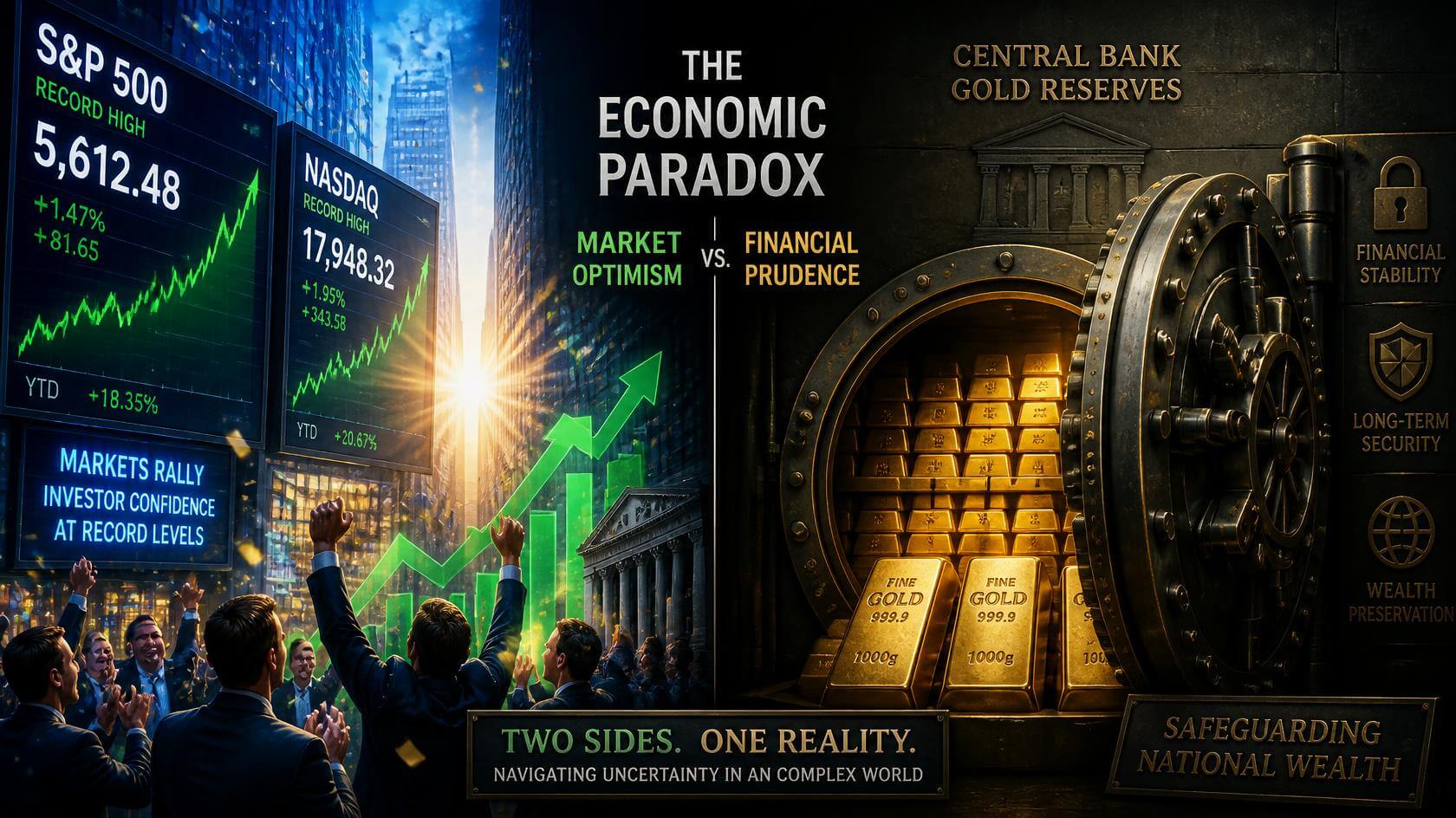
Something strange happened in the first week of August 2026. The American economy lost 23,000 jobs when everyone expected to gain 83,000. Stock markets responded by throwing a party. The S&P 500 jumped to a record 7,757 points. The Nasdaq hit 26,690. Together, they added $2.5 trillion in value in just five days.
This is not how markets are supposed to work. Bad economic news should mean falling prices. But in August 2026, bad news became good news. And that tells us something important: the system can no longer function the way it used to.
While stock traders celebrated, central bankers were doing something very different. They were moving gold. Lots of it. Not just buying. Moving it home. Locking it in their own vaults. A survey of 76 central banks found that 45 percent plan to increase their gold reserves in the next year. That is the highest number ever recorded.
These two stories—markets celebrating job losses and central banks hoarding gold—are not separate. They are two sides of the same coin. One side shows what people want to believe. The other shows what institutions are preparing for.
When Losing Jobs Became Good News
On August 7, 2026, the U.S. Bureau of Labor Statistics released employment data for July. The numbers were terrible.
Table 1: July 2026 Employment Situation
| Indicator | July 2026 | Context |
| Jobs added/lost | -23,000 | Expected: +83,000 |
| Unemployment rate | 4.1% | Unchanged from June |
| Labor force participation | 61.4% | Lowest in 5+ years |
| People who left the workforce | Not counted | Hidden decline |
| Average wage growth | 3.2% | Weakest since May 2021 |
| Previous months revised | -103,000 | May and June combined |
Source: U.S. Bureau of Labor Statistics, August 7, 2026
This was not a small miss. The economy did not just grow slower than expected. It shrank. Twenty-three thousand jobs disappeared. Wages grew at their weakest pace in five years. And when statisticians went back to check May and June, they found another 103,000 jobs that never actually existed.
The labor force participation rate—the share of adults who are working or looking for work—fell to 61.4 percent. That is the lowest level in over five years. When people stop looking for jobs, they disappear from the unemployment statistics entirely. So the 4.1 percent unemployment rate actually hides a deeper problem.
In a normal world, stock markets would have fallen on this news. Fewer jobs means less consumer spending. Less spending means lower corporate profits. Lower profits should mean lower stock prices.
But August 7, 2026 was not a normal day.
The S&P 500 rose 0.62 percent to close at a record high. The Nasdaq jumped 1.3 percent. For the week, the S&P 500 gained 3.6 percent. The Nasdaq gained 5.2 percent. Those were the best weekly gains since April.
Why? Because investors decided that terrible employment data meant the Federal Reserve would not raise interest rates in September. Before the jobs report, futures markets gave a 55 percent chance of a September rate hike. After the report, that probability fell to around 40 percent.
Think about what this means. Markets went up because the economy was too weak to handle normal interest rates. Good news became bad news. Bad news became good news. The entire logic flipped upside down.
This is not a sign of strength. It is a sign that the system has become so fragile that it can only survive if monetary policy stays loose forever.
The Treasury Market’s Silent Scream
While stock markets celebrated, the bond market was telling a different story.
The 10-year U.S. Treasury yield—the most important interest rate in the world—stayed stuck between 4.6 and 4.7 percent throughout early August. That is high. Not catastrophically high, but high enough to create problems.
On August 5, 2026, the U.S. Treasury Department announced its quarterly refunding plan:
Table 2: August 2026 Treasury Refunding
| Security | Amount | Auction Date | Purpose |
| 3-year notes | $58 billion | August 11 | Refinance old debt |
| 10-year notes | $42 billion | August 12 | + raise new cash |
| 30-year bonds | $25 billion | August 13 | |
| Total | $125 billion | Refund $96.3B old debt, raise $28.7B new cash |
Source: U.S. Treasury Department, August 5, 2026
The Treasury also announced that it needs to borrow $739 billion in the July-September quarter. That is $68 billion more than it estimated in May. For October-December, it plans to borrow another $628 billion.
Add those numbers up. In six months, the U.S. government needs to borrow $1.37 trillion. Not to build new infrastructure or fund new programs. Just to keep the lights on and pay interest on existing debt.
This creates a strange situation. Stock markets need the Federal Reserve to keep interest rates low. But the U.S. government is issuing massive amounts of new debt. If investors lose confidence, they will demand higher interest rates to buy that debt. Higher rates would crash the stock market and make government borrowing even more expensive.
The system is trapped. It cannot afford high rates. But it also cannot afford to keep rates too low for too long, because that brings back inflation.
In August 2026, stocks hit record highs while bond yields stayed elevated. Normally, when stocks go up, bond yields go down. They move in opposite directions like a seesaw. But in August, both stayed high. That seesaw is broken.
When traditional relationships break down, it means the rules have changed. And when rules change in financial markets, it usually means something big is coming.
What Central Banks Are Really Doing
While markets were celebrating and governments were borrowing, central banks were doing something they had not done at this scale before.
Between February and May 2026, the World Gold Council surveyed 76 central banks around the world. These are the institutions that manage the monetary reserves of entire nations. The survey asked them a simple question: what are you planning to do with your gold?
The answers were striking.
Key Findings from the 2026 Central Bank Gold Survey:
- 89% expect total global gold reserves to increase in the next year
- 45% plan to increase their own gold holdings—highest ever recorded
- 84% expect gold to be a larger share of reserves in five years
- 74% expect the U.S. dollar’s share of reserves to fall
- 10% moved gold to new overseas storage locations in the past year (up from 2%)
- 9% increased domestic storage—bringing gold home
Source: World Gold Council, June 2026
This is not normal central bank behavior. For decades, central banks treated gold as a relic. Something you inherited from history but did not actively manage. The survey found that only 46 percent now cite “historical legacy” as a reason to hold gold. That number was 62 percent just one year ago.
Gold is no longer a leftover from the past. It has become an active strategic choice.
Why? The survey respondents gave three main reasons:
- Crisis performance (90%): Gold holds value when everything else collapses
- Long-term store of value (84%): It cannot be printed, diluted, or inflated away
- Portfolio diversification (83%): It does not move with stocks or bonds
But there is a fourth reason that central banks are quieter about. Gold cannot be frozen, sanctioned, or seized the way dollar assets can. After the United States froze Russia’s foreign reserves in 2022, every central bank in the world learned a lesson: dollars in New York banks are only yours until Washington decides they are not.
Gold in your own vault is different. It is physical. It is sovereign. It is final.
Ten percent of surveyed central banks moved gold to new locations in the past year. Nine percent increased domestic storage. These are not random numbers. They represent a quiet but unmistakable shift: central banks are moving their most important assets closer to home.
The Dollar’s Long Goodbye
The U.S. dollar remains the world’s dominant reserve currency. But dominant does not mean unchallenged.
Chart: U.S. Dollar Share of Global Reserves
2000: ~71-72%
…
Q4 2025: 56.42%
Q1 2026: 57.13%
Source: International Monetary Fund COFER data
The dollar’s share of global foreign exchange reserves was 57.13 percent in the first quarter of 2026. That is actually up slightly from 56.42 percent at the end of 2025. So the dollar is not collapsing. But zoom out to the year 2000, and the picture changes. Back then, the dollar accounted for over 71 percent of reserves.
That is a 14-percentage-point decline over 26 years. It sounds gradual. It is. But gradual does not mean small.
When you manage trillions of dollars in reserves, a 14-point shift represents hundreds of billions of dollars moving out of dollar assets and into other forms of value. Much of that has gone into gold. Some has gone into euros, yen, and other currencies. And increasingly, central banks are building alternative payment systems that do not rely on dollars at all.
China’s Cross-Border Interbank Payment System (CIPS) now connects thousands of financial institutions across more than 100 countries. It allows trade and investment to settle in yuan without touching the dollar system. Russia built its own messaging system (SPFS) after being cut off from SWIFT. In 2026, a new system called BRICS Pay launched, integrating payment systems from China, India, Brazil, and Russia.
None of these systems are as large or liquid as the dollar system. Not yet. But they exist. They work. And they are growing.
The important point is not that the dollar will disappear tomorrow. It will not. The point is that for the first time in 50 years, credible alternatives are being built. Central banks see this. That is why 74 percent of them expect the dollar’s share to keep falling.
The Illusion and What Breaks It
August 2026 showed us two different realities.
Reality One: Stock markets at record highs. Technology companies posting strong earnings. Investors confident that the Federal Reserve will keep supporting markets. Everything feels fine.
Reality Two: The economy losing jobs. The government borrowing $1.37 trillion in six months. Central banks moving gold home and building exit routes from the dollar system. Treasury yields stuck at levels that make debt expensive.
Both realities are true. But they cannot both be true forever.
The gap between what markets are pricing and what central banks are preparing for has never been wider. Markets are pricing in a world where nothing fundamental changes—where the Federal Reserve can always step in, where government debt keeps growing without consequence, where the dollar remains supreme.
Central banks are preparing for a different world. One where crisis performance matters more than quarterly earnings. Where physical gold matters more than digital promises. Where having your reserves in your own vault matters more than yield.
Who is right?
History suggests that when market prices and institutional behavior diverge this far, institutional behavior wins. Markets can stay irrational longer than you can stay solvent, as the saying goes. But they cannot stay irrational forever.
The August 2026 illusion was this: that terrible economic news could be good news because it postponed the day of reckoning. That record stock prices and record debt could coexist without consequence. That central banks accumulating gold at the highest rate ever was just a footnote, not a warning.
But illusions do not break gradually. They break suddenly. And when they do, the people who prepared—who owned real assets, who understood the system’s limits, who read the warning signs—will be the ones who survive what comes next.
The central banks are reading those signs. The question is: are you?
Glossary
Central Bank: The main bank of a country that controls its money supply, like the Federal Reserve in the United States or the Bank of England. Think of it as the bank that all other banks use.
Federal Reserve (The Fed): The central bank of the United States. It decides interest rates and controls how much money exists in the economy.
Interest Rate: The cost of borrowing money, shown as a percentage. If you borrow $100 at 5% interest, you pay back $105. When the Fed raises rates, borrowing becomes more expensive for everyone.
S&P 500: A collection of 500 large American companies’ stocks used to measure how the overall stock market is doing. When people say “the market went up,” they often mean the S&P 500 went up.
Nasdaq: A stock market index focused on technology companies like Apple, Google, and Amazon.
Treasury (U.S. Treasury): The department of the U.S. government that manages money, collects taxes, and borrows when the government needs more cash than it has.
Treasury Yield: The interest rate the U.S. government pays when it borrows money by selling bonds. A 10-year Treasury yield of 4.7% means if you lend the government money for 10 years, they pay you 4.7% per year.
Reserve Currency: A currency that other countries hold as part of their savings. The U.S. dollar is the world’s main reserve currency, meaning central banks around the world keep dollars in their vaults.
Gold Reserves: Gold bars stored by central banks as part of their national savings. Unlike paper money, gold cannot be printed or created out of nothing.
Labor Force Participation Rate: The percentage of adults who are either working or actively looking for work. When this falls, it means people have given up looking for jobs, which is usually a bad sign.
SWIFT: A messaging system that banks around the world use to send payment instructions to each other. If you are cut off from SWIFT, you are largely cut off from the global financial system.
Futures Market: A market where people bet on what will happen in the future. “Fed funds futures” let investors bet on what the Federal Reserve will do with interest rates.
Fiscal Space: How much more a government can borrow before lenders start worrying it cannot pay them back. When fiscal space shrinks, it becomes harder and more expensive to borrow.
BRICS: A group of countries (originally Brazil, Russia, India, China, South Africa) working to create alternatives to Western-dominated financial systems. The group has expanded to 11 members as of 2026.
Cross-Border Payment System: A way to send money between countries without using U.S. dollars or American banks. China, Russia, and others are building these systems to reduce dependence on the dollar.
Bond-Stock Correlation: The mathematical relationship between bond prices and stock prices. Normally when one goes up, the other goes down. When this relationship breaks, it signals that something unusual is happening in markets.
Sources
- S. Bureau of Labor Statistics, “The Employment Situation — July 2026,” released August 7, 2026
- S. Treasury Department, “Treasury Announces Financing Estimates and Quarterly Refunding,” Press Release SB0590, August 5, 2026
- World Gold Council, “Central Bank Gold Reserves Survey 2026,” June 2026
- International Monetary Fund, COFER Database (Currency Composition of Official Foreign Exchange Reserves), Q1 2026
- CNBC, Reuters, Bloomberg market data, August 2-8, 2026
- Bank for International Settlements, research papers on fiscal-financial stability nexus and bond-stock correlation dynamics