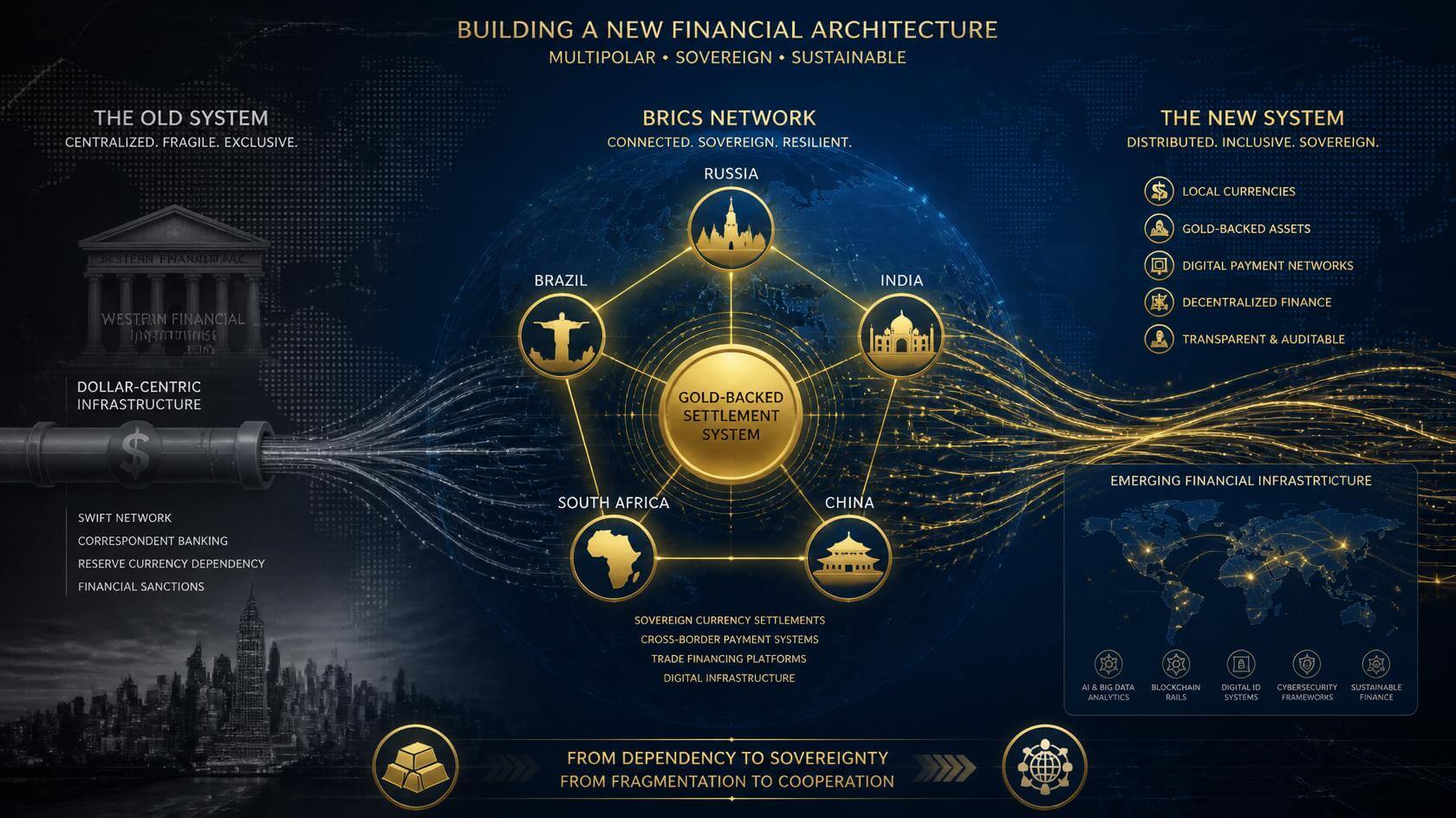
For fifty years, talking about replacing the dollar was like talking about the weather. Everyone did it. Nobody changed anything.
Then something shifted. Not with announcements. Not with speeches. With plumbing.
On October 31, 2025, a digital settlement instrument called the BRICS Unit started its pilot phase. By January 2026, it was processing real energy and raw material trades. Not in dollars. In a basket backed forty percent by gold and sixty percent by the currencies of Brazil, Russia, India, China, and South Africa.
At the same moment, another piece of infrastructure—a cross-border payment platform called mBridge—crossed fifty-five billion dollars in transaction volume. It started at twenty-two million dollars in October 2022. That is a 2,500-fold increase in less than four years.
And in the Strait of Hormuz, when Iran soft-closed the waterway in February 2026, oil traders could not wait for diplomats to solve the problem. They needed to move cargo. Some paid in yuan. Some used cryptocurrency. They bypassed dollar clearing because the alternative rails were already there, waiting.
This is not a revolution. This is infrastructure replacement. The old system is still running. But new pipes have been laid. And when the old ones break—or get turned off—the flow does not stop anymore.
The Plumbing Nobody Watched Being Installed
The BRICS Unit is not a currency you will use to buy coffee. It is a wholesale settlement tool. Think of it as the accounting system banks use when they need to settle large cross-border trades without picking whose currency to use.
Here is how it works. When two countries trade, they usually settle in a third currency—most often the dollar. But that creates dependency. If the dollar system gets sanctioned, frozen, or disrupted, the trade stops.
The Unit solves this by creating a neutral middle layer. Forty percent of its value comes from physical gold. Gold does not have a central bank. It cannot be printed. It cannot be frozen by any government. The other sixty percent comes from five currencies, weighted equally at twelve percent each. No single country dominates.
Table 1: BRICS Unit Composition
| Component | Percentage | Purpose |
| Physical Gold | 40% | Stability anchor, neutral asset, no counterparty risk |
| Brazilian Real | 12% | Equal representation |
| Chinese Yuan | 12% | Equal representation |
| Indian Rupee | 12% | Equal representation |
| Russian Ruble | 12% | Equal representation |
| South African Rand | 12% | Equal representation |
Source: IRIAS pilot documentation, January 2026
Why does this matter? Because it works. Energy trades that would have taken days to clear through correspondent banks now settle in real time on a permissioned blockchain. The gold backing keeps the value stable. The currency basket keeps it flexible.
This is not theoretical. This launched in January 2026. It is processing real flows right now.
The Payment Rails That Grew in the Shadows
While the world watched headlines about “de-dollarization,” a Chinese-led platform called mBridge was being built by central banks.
It started as a pilot project run by the Bank for International Settlements. In October 2024, the BIS handed it over to the participating central banks: China, Hong Kong, Thailand, the United Arab Emirates, Saudi Arabia, and Mongolia.
By January 2026, mBridge had processed over fifty-five billion dollars in cross-border payments. More than four thousand transactions. And here is the critical detail: ninety-five percent of the settlement volume was in China’s digital yuan.
Chart 1: mBridge Transaction Volume Growth (2022–2026)
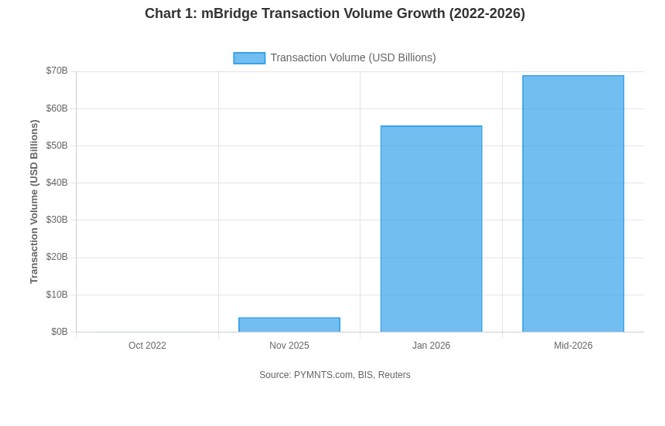
Figure 1. mBridge cumulative transaction volume, October 2022–mid-2026
Data Points: October 2022: $22 million · November 2025: $4 billion (4,000+ transactions) · January 2026: $55.49 billion · Mid-2026: ~$69 billion (RMB 470 billion) · Growth: 2,500× in less than 4 years
Source: PYMNTS.com, BIS, Reuters
This is not a replacement for SWIFT. It is an alternative rail. When one path is blocked, the other exists. That is the strategic value. Not destruction of the old system. Just insurance that trade can keep flowing even if access to the old system gets cut off.
And the participating central banks are not fringe players. Saudi Arabia is on that list. The country that built the petrodollar system is now building the payment infrastructure to work around it.
When Crisis Forces the Shift
Theory becomes infrastructure when crisis leaves no other choice.
On February 28, 2026, the Strait of Hormuz effectively closed to normal traffic. Iran created what analysts called a “de facto toll booth.” Ships carrying oil had to provide manifests to the Iranian Revolutionary Guard Corps. And some were told they could only pass if payment was settled in yuan.
The Strait of Hormuz carries twenty-five percent of the world’s seaborne crude oil and twenty percent of its liquefied natural gas. When it closes, the global economy does not have time to wait for diplomatic solutions.
So traders used what was available. Yuan settlement through China’s CIPS system. Cryptocurrency in some cases. Shadow banking networks. Anything that worked.
By late March 2026, regular traffic through the strait had collapsed by ninety-four percent. Insurance premiums hit record levels. Oil prices spiked. But some cargo still moved. Because the alternative payment channels existed.
This was not a policy decision. This was a forcing function. The infrastructure was already built. The crisis simply revealed that it worked.
The Silent Gold Rush
While payment rails were being built, central banks were buying gold at a pace not seen in decades.
Poland has been the most aggressive. In the first five months of 2026, the National Bank of Poland added sixty-four tonnes of gold to its reserves. Its total holdings reached 614 tonnes by the end of May. The stated goal is seven hundred tonnes.
Why? Because gold cannot be frozen. When Western nations froze Russian foreign exchange reserves in 2022, every central bank in the world learned a lesson. Dollars and euros held in foreign banks are not really yours if geopolitics turn against you. But gold held in your own vaults is.
China has now bought gold for twenty consecutive months. In June 2026 alone, it added nearly fifteen tonnes—the largest single-month purchase since 2023. Total official reserves reached 2,346 tonnes.
But here is the striking detail. Gold still makes up less than ten percent of China’s total foreign exchange reserves. There is enormous room to keep buying.
Table 2: Central Bank Gold Accumulation (2026)
| Country | Buying Streak | 2026 Purchases (YTD) | Total Reserves | Key Detail |
| Poland | Ongoing | 64 tonnes (Jan–May) | 614 tonnes | Target: 700 tonnes |
| China | 20 consecutive months | ~48 tonnes (Jan–Jun) | 2,346 tonnes | Gold <10% of reserves |
| Czech Republic | 38 consecutive months | Ongoing | Not disclosed | Consistent buyer |
Source: World Gold Council, Kitco, National Bank of Poland
And the shift is not just about quantity. It is about location. Central banks are moving gold out of traditional storage hubs like the Bank of England and the Federal Reserve. They are bringing it home. Or spreading it across multiple locations to reduce concentration risk.
A World Gold Council survey from June 2026 found that forty-five percent of central banks plan to increase their gold holdings in the next twelve months. That is a record high.
Eighty-nine percent expect global gold reserves to increase.
That is not a prediction. That is a plan.
The Petrodollar Did Not Die. It Just Got Alternatives.
The petrodollar system is not dead. Oil is still priced in dollars. Most of it still settles in dollars. The United States still has the deepest and most liquid capital markets in the world.
But the system is no longer the only option. And that changes everything.
When Saudi Arabia joins a cross-border payment platform that settles in digital yuan, that is not an attack on the dollar. It is insurance. When the New Development Bank finances twenty-five percent of its projects in local currencies—with a target of thirty percent by the end of 2026—that is not revolution. It is diversification.
Table 3: Dollar’s Declining Reserve Share
| Year | Dollar Share of Global Reserves | Change |
| 1999 | 71% | Baseline |
| 2020 | ~58% | −13 percentage points |
| 2026 Q1 | 57.13% | −13.87 percentage points total |
Source: IMF COFER data, Statista
The dollar has lost nearly fourteen percentage points of global reserve share in twenty-seven years. That is slow. That is gradual. But it is persistent.
And every percentage point lost is a percentage point that went somewhere else. Much of it went to gold. Some went to “nontraditional” currencies like the Australian dollar, the Canadian dollar, the Swedish krona. Some went to yuan.
The system is not collapsing. It is evolving into something multipolar. The dollar will remain dominant for years, maybe decades. But it will share the stage.
What the Infrastructure Tells Us
Infrastructure does not lie. Speeches lie. Promises lie. Announcements lie. But when a payment system processes fifty-five billion dollars in real transactions, that is truth.
When central banks add hundreds of tonnes of gold to their vaults, that is truth.
When oil traders settle cargo in yuan during a crisis, that is truth.
The BRICS Unit, mBridge, BRICS Pay—these are not future projects. They are operational systems. They have transaction volumes. They have user bases. They work.
The BRICS Pay infrastructure connects Brazil’s Pix, India’s UPI, China’s CIPS, and Russia’s SPFS into a single network. It can process twenty thousand messages per second. That is not a prototype. That is production-grade architecture.
The 2026 BRICS summit in New Delhi is expected to formalize the linkage of Central Bank Digital Currencies across member states. That means instant wholesale settlement between central banks without touching the dollar system at all.
None of this destroys the dollar. But all of it reduces dependency on it.
The Inch-by-Inch Replacement
Here is what makes this moment different from all the previous “dollar collapse” predictions.
This is not happening through a dramatic break. There is no single moment when the old system falls and the new one rises. Instead, the new system is being built in parallel. Piece by piece. Transaction by transaction. Tonne of gold by tonne of gold.
When one central bank buys gold, that is a decision. When forty-five percent of all central banks plan to buy more in the next year, that is a structural shift.
When one payment goes through mBridge, that is a test. When fifty-five billion dollars flows through it, that is a working system.
When Iran demands yuan for one shipment, that is an experiment. When the Strait of Hormuz crisis forces dozens of tankers to settle outside dollar rails, that is proof of concept.
The global monetary system is not being overthrown. It is being quietly, steadily, technically replaced. The replacement is happening underneath the surface. By the time the shift is obvious to everyone, it will already be complete.
And the people building the replacement are not revolutionaries. They are central bankers. Engineers. Payment system designers. They are not trying to create chaos. They are trying to create redundancy. Alternatives. Options.
But the result is the same. A world where the dollar is no longer the only way to move value across borders. A world where sanctions lose some of their power. A world where financial sovereignty is not just a talking point but a working reality backed by operational infrastructure.
That world is not coming.
It is here.
Glossary
BRICS: Brazil, Russia, India, China, South Africa. A group of major emerging economies that have been working together since 2006. Think of it like a club for big countries that are not the United States or Europe.
BRICS Unit: A new digital tool that helps countries trade with each other without using dollars. It is forty percent backed by real gold and sixty percent backed by the currencies of the BRICS countries. Imagine it as a shared wallet that five friends created so they do not have to use someone else’s money when they trade.
mBridge: A payment system built by central banks that lets countries send money to each other instantly without using SWIFT or the dollar. Think of it like a group chat for banks, but for money transfers instead of messages.
SWIFT: The old system that banks use to send money across borders. It is based in Belgium and most of the world’s international payments go through it. If you get kicked out of SWIFT, it is very hard to do international business.
CIPS (Cross-Border Interbank Payment System): China’s version of SWIFT. It lets banks settle payments in yuan without touching the dollar or SWIFT system.
Petrodollar: The system where oil is priced and sold in U.S. dollars. It started in the 1970s when the United States made a deal with Saudi Arabia. Oil producers get dollars for their oil, then invest those dollars back into U.S. assets like Treasury bonds. It creates constant demand for dollars around the world.
Central Bank: The main bank of a country. It controls the money supply and holds the country’s reserves. In the United States it is the Federal Reserve. In Europe it is the European Central Bank. Think of it as the bank that banks go to.
Foreign Exchange Reserves: The savings account of a country. Central banks hold reserves in different currencies and gold so they can pay for imports, defend their currency, or handle emergencies. It is like the emergency fund of a nation.
Yuan (also called Renminbi): China’s currency. The official name is renminbi, but yuan is the unit (like “dollar” is the unit of U.S. currency). One yuan is worth about fourteen U.S. cents as of mid-2026.
Gold Backing: When a currency or financial instrument is supported by real physical gold. If something is forty percent gold-backed, it means forty percent of its value comes from actual gold that is stored somewhere. This makes it more stable because gold cannot be printed like paper money.
Settlement: The final step in a payment where money actually moves from one account to another. You can think of it like the moment when cash changes hands. Before settlement, it is just a promise to pay. After settlement, the money has moved.
Sanctions: Economic punishments that countries use against each other. Usually it means freezing bank accounts, blocking trade, or cutting off access to financial systems. The United States uses sanctions a lot because so much of the global financial system runs through dollars and U.S. banks.
Strait of Hormuz: A narrow waterway between Iran and Oman. About twenty-five percent of the world’s oil flows through it. It is only twenty-one miles wide at its narrowest point. If it closes, global oil prices spike immediately.
Correspondent Banking: When a bank in one country uses a bank in another country to move money. For example, a Brazilian bank might use a U.S. bank as its correspondent to settle dollar payments. If you lose access to correspondent banking, international trade becomes very difficult.
Permissioned Blockchain: A type of blockchain where only approved participants can join and make transactions. Unlike Bitcoin, which anyone can use, a permissioned blockchain is controlled by a specific group. Think of it like a private club versus a public park.
Reserve Currency: A currency that central banks around the world hold in large amounts as part of their reserves. The U.S. dollar is the main reserve currency. Countries hold dollars because they need them to buy oil, pay debts, and trade internationally.
De-dollarization: The process of reducing dependence on the U.S. dollar for international trade and reserves. It does not mean the dollar disappears. It means countries create alternatives so they are not completely dependent on it.
CBDC (Central Bank Digital Currency): Digital money issued directly by a central bank. It is like cash, but electronic. China’s digital yuan is a CBDC. Think of it as government-issued digital cash, not private money like Bitcoin.
New Development Bank: A bank created by the BRICS countries in 2014 to fund infrastructure projects in emerging economies. It is based in Shanghai and was designed as an alternative to Western-dominated institutions like the World Bank.
Sources
- World Gold Council — Central Bank Gold Reserves Survey 2026
- Bank for International Settlements — Project mBridge Documentation
- PYMNTS.com — mBridge Transaction Volume Reports (January 2026)
- International Research Institute for Advanced Systems (IRIAS) — BRICS Unit Pilot Documentation
- National Bank of Poland — Gold Reserve Reports (May 2026)
- People’s Bank of China — Monthly Reserve Updates
- Kitco News — Central Bank Gold Purchases Data
- International Monetary Fund — Currency Composition of Official Foreign Exchange Reserves (COFER)
- Atlantic Council — Inside Tehran’s Toll Booth Analysis
- Fortune — Strait of Hormuz Yuan Settlement Reports
- New Development Bank — General Strategy 2022–2026
- Asia Times — Iran Hormuz Analysis
- The Mag Post — BRICS Unit Infrastructure Analysis
- Reuters — Cross-Border CBDC Platform Reports