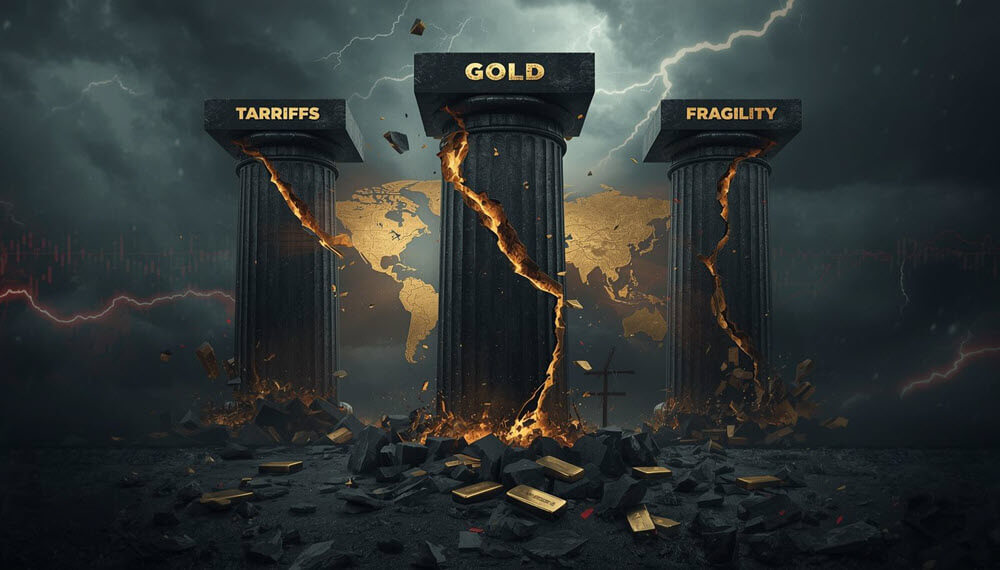
Tariffs, gold, and fragility — three breakpoints reshaping the global economic order in April 2026
Arzu ALVAN / April 2026
There is a strange moment when you realize that what looked like three separate problems are actually three parts of the same architecture beginning to fail.
In April 2026, the global economic system is showing cracks along three visible fault lines. First, the trade system is being redrawn through tariffs — not as policy tools, but as weapons of reorganization. Second, central banks are accumulating gold at rates that signal something deeper than portfolio di‐ versification. Third, growth indicators are flashing signals that contradict each other — expansion in some places, fragility warnings in others.
On the surface, these three phenomena look unrelated. Trade policy is about commerce. Gold is about reserves. Growth is about cycles.
But beneath that surface, they are connected. They are not three separate stories. They are three symptoms of the same underlying shift: the quiet dissolution of the post-1971 dollar-centric global order and the emergence of something else.
This is not a prediction of collapse. It is an observation of reorganization. Slowly. Quietly. With real numbers behind it.
Let me walk through what the data is showing.
1. The Map of Simultaneous Fractures
When a building begins to fail, you do not see one crack. You see several, in different places, at the same time. That is what structural failure looks like.
In April 2026, three major cracks are visible:
- Tariff escalation that has pushed the U.S. effective tariff rate to 8.9%, the highest since 1947, generating $224.8 billion in customs revenue in just 14 months.
- Central bank gold purchases totaling approximately 755-850 tonnes projected for 2026, following three consecutive years of over 1,000 tonnes annually — a pattern not seen since the 1970s.
- Global growth deceleration to 1%, with manufacturing PMI showing expansion but fragility indicators widening across emerging markets.
These are not minor adjustments. These are structural shifts.
The question is not whether these three things are happening. The question is whether they are hap‐ pening independently or whether they are part of the same underlying reconfiguration.
I believe the latter. Let me show you why.
2.
The First Breakpoint: Trade Routes Drawn with Tariffs
Tariffs are no longer simply about protecting industries. In 2026, they have become tools for restructuring the global economic map.
The Numbers Behind the Shift
As of February 2026, the United States has implemented a cascade of tariff measures:
| Tariff Type | Rate | Coverage | Revenue Impact |
| Section 232 (Steel/ Aluminum) | 40.1% average | Metals & derivatives | Highest product cat‐ egory |
| Section 301 (China) | 31.6% average | Chinese imports | $224.8B total (Jan 2025–Feb 2026) |
| Section 122 (Global) | 10% | ~$1.2 trillion in im‐ ports | Temporary (150 days) |
| Section 232 (Pharma‐ ceuticals) | 100% (patented),
20% (onshoring) |
Many pharmaceutic‐ als | Starting April 2026 |
Source: Penn Wharton Budget Model, U.S. Trade Representative, Global Trade Alert
The effective tariff rate in the U.S. reached 8.9% in February 2026. To understand what this means: the last time the U.S. had tariff rates near this level was in 1947, in the immediate post-WWII
reconstruction period.
China faces the highest tariffs among major trading partners, at 31.6%. When combined with base du‐ ties, some Chinese electric vehicle components now carry cumulative effective rates above 145%.
This is not trade policy. This is economic redesign.
The Supply Chain Exodus
The impact is not theoretical. It is measurable.
- 68% of trade professionals now rank supply chain management as their top concern — nearly double from the previous year.
- 65% of companies are changing sourcing
- 57% are renegotiating supplier
- 51% are nearshoring or moving manufacturing back to the S.
The share of imports from Canada and Mexico claiming USMCA exemptions surged to 86.3% by February 2026. This is not coincidence. This is strategic rerouting.
At the same time, “connector economies” — Cambodia, Egypt, Vietnam, Indonesia — are emerging as intermediaries in the U.S.-China trade slump, acting as pass-through nodes to stabilize flows.
Think of it this way: when a major river is dammed, the water does not stop flowing. It finds new routes. That is what is happening to global trade.
The Underlying Logic
Tariffs are being used to:
- Force supply chain
- Build leverage for bilateral
- Slow China’s manufacturing dominance without direct
The U.S. Trade Representative initiated 60 new Section 301 investigations into major trading partners, including China, regarding forced labor and excess manufacturing capacity. These are not random.
They are systematic.
This is the first breakpoint: the trade system is being rewritten, and tariffs are the ink.
3.
The Second Breakpoint: Central Banks Vote with Gold
While tariffs reshape trade, central banks are sending a different signal. They are buying gold. A lot of it. And they are doing it quietly.
The Silent Accumulation
In early 2026, central banks are projected to purchase 755-850 tonnes of gold. This is slightly lower
than the 1,000+ tonnes acquired annually from 2022-2025, but it is still double the pre-2022 average of 400-500 tonnes.
Let me put this in perspective. Before 2022, central bank gold purchases averaged around 450 tonnes per year. Since 2022, that figure more than doubled.
Why 2022?
Because in 2022, Western governments froze Russia’s central bank reserves held in dollars and euros. That was the watershed moment. It sent a message to every central bank in the world: dollar reserves held in Western institutions can be confiscated.
Who Is Buying, and Why
Here are the leading gold accumulators in early 2026:
| Country | Gold Added
(tonnes, Feb 2026) |
Total Reserves (tonnes) | % of Reserves |
| Poland | 20+ | 570 | 31% |
| Uzbekistan | 16.48 | Growing | – |
| Kazakhstan | 6.51 | Growing | – |
| Malaysia | 4.98 | Growing | – |
| Czechia | 3.36 | 36 months consecut‐ ive | – |
| China | 2.18 | 16 months consecut‐ ive | – |
Source: World Gold Council, Visual Capitalist, IndexBox
Poland is buying gold as a security measure, due to its position on NATO’s eastern flank. Its target is 700 tonnes, up from 570 now.
China is adding gold every month — 16 consecutive months of purchases. This is not speculation. This is strategic de-dollarization.
Uzbekistan, Kazakhstan, and other Central Asian economies are accelerating purchases. These are countries that watched Russia’s reserves freeze. They learned.
Who Is Selling
Interestingly, two countries are net sellers in 2026:
- Russia: -15.55 tonnes (mounting fiscal strain from wartime spending and sanctions)
- Turkey: -8.08 tonnes (domestic policy to stabilize the lira)
Russia’s gold sales are forced. Turkey’s are tactical. But the broader pattern is clear: emerging markets are buying, developed markets are holding, and two outliers are selling under pressure.
The Vote That Is Not Being Discussed
Central banks do not buy 850 tonnes of gold per year because they think it will go up 10%. They buy it because they do not trust the system they are embedded in.
Gold has no yield. It cannot be frozen by a foreign government. It cannot be inflated away by a central bank outside your control. It is the only reserve asset that is genuinely neutral.
BRICS+ nations held 17.4% of global gold reserves in 2025, up from 11.2% in 2019.
This is not portfolio management. This is a vote of no confidence. Not in the dollar as a currency, but in the system built around it.
This is the second breakpoint: central banks are quietly building an alternative foundation, and gold is the material.
4.
The Third Breakpoint: Growth Signals Under Pressure
On the surface, the global economy looks stable. Manufacturing is expanding. The U.S. economy grew 4.3% in Q3 2025. The PMI is above 50.
But if you look closer, the dashboard is lighting up with warning signals.
The Contradictory Indicators
The U.S. Manufacturing PMI reached 52.7% in March 2026, marking the third consecutive month of expansion and the fastest growth since August 2022. A PMI above 50 signals expansion.
But look beneath that number:
- The Prices Index jumped to 3% in March, the highest since June 2022. Input costs are surging.
- The Employment Index remained in contraction at 7%, the fifth consecutive month below 50.
- 64% of survey respondents made negative comments, citing tariffs (20%) and the Middle East war (40%).
- The inventory spread widened to -2.7 percentage points, historically a leading indicator of PMI de‐
So we have expansion in production, but rising costs, falling employment, and negative sentiment. This is not healthy growth. This is fragile momentum.
Global Growth: The Slowdown Beneath the Surface
The International Monetary Fund (IMF) projects global growth at 3.1% for 2026, down from earlier forecasts of 3.3%. This is below the historical average of 3.7% (2000-2019).
But that is the reference forecast. It assumes the Middle East conflict remains limited and energy prices rise moderately (19%).
The IMF also published two alternative scenarios:
| Scenario | Global Growth 2026 | Inflation 2026 | Assumptions |
| Reference | 3.1% | Modest rise | Limited conflict, mod‐ erate energy price rise |
| Adverse | 2.5% | 5.4% | Further disruption, higher energy prices |
| Severe | 2.0% | 6.0%+ | Prolonged conflict, major supply disrup‐ tion |
Source: IMF World Economic Outlook, April 2026
Historically, global growth at or below 2.0% is associated with global recession.
The difference between the reference forecast and the severe scenario is 1.1 percentage points of global GDP. That is the width of the fragility band.
Fragility Indicators Widening
Several early warning indicators are flashing:
- Fiscal strain: Rising interest-to-revenue ratios in emerging markets, narrowing fiscal
- External vulnerabilities: Declining foreign exchange reserves, widening current account deficits, clustered external debt
- Labor market stress: Global jobs gap projected at 408 million in 2026; 1 billion workers in informal employment.
- Supply chain delays: Supplier deliveries slowing for the fourth consecutive
- Geopolitical risk premium: Middle East conflict generating spillovers in energy, food, fertilizer
The manufacturing sector is expanding, but the foundation is cracking.
The Pattern: Growth Without Resilience
This is what economists call “growth without resilience.” The surface indicators show expansion. But the structural indicators show vulnerability.
Think of it as a car accelerating downhill. The speedometer shows high speed. But the brakes are worn, the road is wet, and the curve is ahead.
This is the third breakpoint: growth is continuing, but the margin for error is vanishing.
5. The Pattern Beneath the Surface
Now step back. Look at the three breakpoints together.
- Tariffs are forcing supply chains to
- Central banks are accumulating gold as a hedge against system
- Growth is continuing, but fragility is
These are not independent. They are connected.
The Logic of the Connection
Tariffs create uncertainty. Uncertainty slows investment. Slower investment weakens growth resilience. Weakening resilience increases system risk. Increased system risk drives central banks toward non- dollar reserves. The most liquid non-dollar reserve is gold.
But there is a deeper logic.
The post-1971 global order was built on three pillars:
- Dollar-denominated trade (settled in dollars, financed in dollars).
- Dollar reserves held in S. Treasuries (trust that they would not be confiscated).
- Global growth driven by integrated supply chains (efficiency through specialization).
Now look at 2026:
- Trade is being re-denominated and re-routed through tariffs and bilateral The yuan is rising as an alternative settlement currency.
- Dollar reserves are being diversified into gold because the “trust” assumption broke in 2022 when Russian reserves were frozen.
- Integrated supply chains are being fragmented into regional blocs (nearshoring, friend-shoring, connector economies).
All three pillars are cracking. Not collapsing. Cracking.
The Reorganization, Not the Collapse
This is not the end of the dollar system. The dollar is still the dominant reserve currency. U.S. Treasuries are still the deepest market. The U.S. is still the largest economy.
But the system is being reorganized around it. Not replaced. Reorganized. Countries are building parallel infrastructure:
- Payment rails that bypass SWIFT (China’s CIPS, Russia’s SPFS).
- Trade agreements that settle in local currencies (yuan-ruble, yuan-riyal).
- Reserve diversification into gold, reducing dependence on any single
This is not happening in a single announcement. It is happening slowly, in 20-tonne gold purchases, in 10% tariffs, in PMI employment indices below 50.
The system is not breaking. It is bifurcating.
6. Final Reflections
Let me be direct.
I am not predicting a financial crisis in 2026. I am not saying the dollar will collapse. I am not saying global trade will halt.
But I am saying this: three structural breakpoints are happening simultaneously, and they are connec‐ ted.
Tariffs are not just trade policy. They are tools of economic geography, redrawing where things are made and who controls the routes.
Gold purchases are not just reserve management. They are a vote of no confidence in the durability of the existing system, a hedge against the possibility that the rules can change suddenly.
Growth fragility is not just a cyclical slowdown. It is the symptom of a system under strain, where the buffers are thinner and the shocks are coming faster.
When you see three pillars crack at once, you do not wait for the building to fall. You watch how people start moving. Where they place their weight. What they build next door.
And right now, the data is clear. They are moving. Quietly. Strategically. With real capital behind it.
The old order is still standing. But if you press your hand against the structure, you will feel it. A vibra‐ tion. A shift. Something is being built in parallel. Slowly. Patiently. With gold, with tariffs, with fragility as the teacher.
Key Concepts
Tariff: A tax on imported goods. In 2026, tariffs are being used not just to protect domestic industries, but to force companies to move factories to different countries. Think of it as a tool to redraw the map of where things are made.
Section 232 / Section 301 / Section 122: Different legal tools the U.S. uses to impose tariffs. Sec‐ tion 232 is for “national security” (used for steel, aluminum, pharmaceuticals). Section 301 is for “un‐ fair trade practices” (used mainly against China). Section 122 is for “national emergency” (used for a temporary 10% global tariff in 2026).
Effective Tariff Rate: The average tariff rate across all imports, weighted by the value of goods. In February 2026, the U.S. effective tariff rate was 8.9%, the highest since 1947.
Central Bank Gold Reserves: Gold owned by a country’s central bank as part of its official reserves. Unlike dollars or euros, gold cannot be frozen or controlled by another country. This makes it attractive during times of geopolitical tension.
De-dollarization: The process of reducing reliance on the U.S. dollar for trade and reserves. Coun‐ tries do this by settling trade in local currencies (like yuan or rupees) and holding more reserves in gold or other assets instead of U.S. Treasuries.
PMI (Purchasing Managers’ Index): A survey of companies that buy materials for manufacturing. A number above 50 means the sector is expanding; below 50 means it is contracting. The U.S.
Manufacturing PMI was 52.7% in March 2026, showing expansion.
Fragility: Economic vulnerability — when a country or system has little room to absorb shocks. High debt, low reserves, dependence on imports, political instability, all increase fragility.
Nearshoring / Friend-shoring: Moving production closer to home (nearshoring) or to countries that are political allies (friend-shoring). This is the opposite of globalization, where production went to the cheapest location regardless of politics.
BRICS+: A group of countries (Brazil, Russia, India, China, South Africa, plus recent additions like
Egypt, Ethiopia, Iran, UAE) that are trying to build alternatives to Western-dominated financial institu‐ tions.
Connector Economies: Countries like Vietnam, Cambodia, Egypt, Indonesia that act as intermediar‐ ies in trade between larger economies. For example, Chinese goods might be assembled in Vietnam and then exported to the U.S., avoiding direct China-U.S. tariffs.
Fiscal Space: A government’s ability to spend money without causing a debt crisis. If your debt is already high and interest rates are rising, you have little fiscal space — you cannot borrow more to respond to a crisis.
Inventory Spread: The difference between manufacturers’ inventories (what factories have in stock) and customers’ inventories (what buyers have in stock). A negative spread means customers already have a lot of goods, so they may order less in the future.
Disclaimer
This article is for informational and educational purposes only. It does not constitute investment ad‐
vice, financial advice, or a recommendation to buy or sell any asset. The views expressed are those of the author based on publicly available data as of April 2026. Economic forecasts are inherently uncer‐ tain and subject to change. Readers should conduct their own research and consult with a qualified
financial advisor before making any investment decisions.
References & Data Sources
-
- Penn Wharton Budget Model (April 2026), “Effective Tariff Rates and Revenues: Updated April 15,
2026”
https://budgetmodel.wharton.upenn.edu/p/2026-04-15-effective-tariff-rates-and-revenues-
updated-april-15-2026/
- U.S. Trade Representative (2026), “2026 Trade Policy Agenda”
https://ustr.gov/sites/default/files/files/Press/Releases/
2026/2026%20Trade%20Policy%20Agenda.pdf
- Thomson Reuters (2026), “2026 Global Trade Report”
https://www.thomsonreuters.com/en-us/posts/corporates/2026-global-trade-report/
- UNCTAD (January 2026), “Global Trade Update: Top Trends Redefining Global Trade in 2026”
https://unctad.org/publication/global-trade-update-january-2026-top-trends-redefining-global-
trade-2026
- World Gold Council (April 2026), “Central Bank Gold Statistics: Central Banks Stay the Course on
Gold, February 2026”
https://www.gold.org/goldhub/gold-focus/2026/04/central-bank-gold-statistics-central-banks-stay-
course-gold-february
- Visual Capitalist (2026), “Ranked: Central Banks Buying and Selling Gold in 2026”
https://pbs.twimg.com/media/HGG0Z_2bUAAfFBj.jpg
- J.P. Morgan Global Research (2026), “Gold Prices: 2026 Outlook”
https://www.jpmorgan.com/insights/global-research/commodities/gold-prices
- OnlineGold (2026), “Central Bank Gold Reserves 2026: Analysis”
https://onlinegold.org/analysis/central-bank-gold-reserves-2026/
- ISM (April 2026), “Manufacturing PMI Report: March 2026”
https://www.morningstar.com/news/pr-newswire/20260401la23016/manufacturing-pmi-at-527-
march-2026-ism-manufacturing-pmi-report
- S&P Global (April 2026), “Flash US Manufacturing PMI”
https://www.pmi.spglobal.com/Public/Home/PressRelease/
- IMF (April 2026), “World Economic Outlook: Global Economy in the Shadow of War”
https://www.imf.org/en/publications/weo/issues/2026/04/14/world-economic-outlook-april-2026
- UNCTAD (2026), “World Economic Situation and Prospects 2026”
https://unctad.org/publication/world-economic-situation-and-prospects-2026
10
- World Bank (2026), “Global Economic Prospects”
https://www.worldbank.org/en/publication/global-economic-prospects
- EconomicLens (2026), “The Risk of a Global Recession in 2026: Early Warning Indicators”
https://economiclens.org/the-risk-of-a-global-recession-in-2026-early-warning-indicators-and-
policy-responses/
- Trading Economics (2026), “United States Business Confidence”
https://tradingeconomics.com/united-states/business-confidence