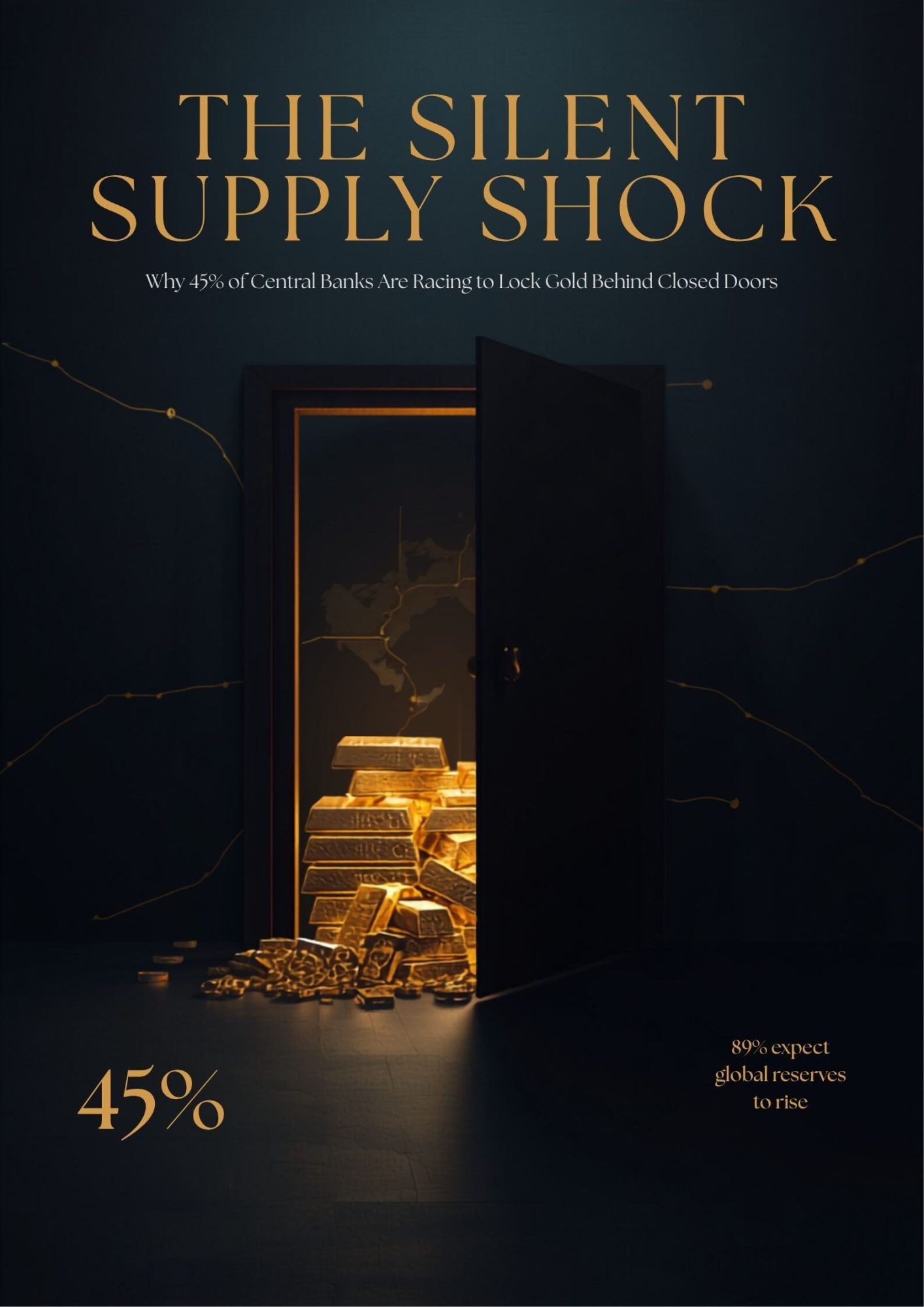
Something profound is happening in the vaults of the world’s central banks. And almost nobody is talking about it.
In June 2026, the World Gold Council released survey results that should have made front-page news everywhere. Here is the number that matters: 45% of the world’s central banks plan to increase their gold holdings in the next twelve months. That is the highest percentage ever recorded in the survey’s nine-year history.
Even more striking: 89% of central banks expect global gold reserves to rise.
Let me be clear about what this means. This is not about central banks making a bet on the gold price. This is about governments scrambling to secure physical access to gold before the door closes completely.
The world is not watching a financial trend. It is watching a race. And the prize is not profit. The prize is access.
The Number Nobody Saw Coming
For decades, central banks were net sellers of gold. They believed the “barbarous relic” argument. Gold was old. Dollars and euros were modern and efficient. Why hold an inert metal when you could hold interest-bearing Treasury bonds?
That era is over.
Since 2022, central banks have been buying gold at a pace the modern world has never seen. In 2022, they purchased 1,082 tonnes. In 2023, 1,037 tonnes. In 2024, 1,045 tonnes. Even in 2025, when prices soared and some expected demand to cool, they still bought 863 tonnes.
This is not a cycle. This is a structural shift.
But here is what makes 2026 different: the intent has intensified. Nearly half of all central banks are now publicly stating they will increase their holdings. Not “maybe.” Not “considering.” They are moving.
What Changed in February 2022
Every central banker in the world remembers the date: February 24, 2022.
That was the day the G7 decided to freeze approximately $300 billion of Russia’s foreign exchange reserves. Not confiscate. Not sanction specific individuals. They froze the reserves of an entire central bank—a G20 economy.
This was unprecedented.
For decades, the unspoken rule of the international financial system was simple: sovereign reserves are sacred. A nation’s foreign exchange holdings, held in accounts at the Federal Reserve or the Bank of England, were considered untouchable. They were the ultimate safe asset.
That assumption died in February 2022.
Central banks around the world—from Beijing to Warsaw to New Delhi—watched and drew the same conclusion: electronic assets held in someone else’s jurisdiction can be switched off with a single political decision.
The term that emerged in financial circles was “weaponization.” The dollar and euro, once seen purely as neutral stores of value, were now understood to carry political risk.
Gold does not carry that risk. Gold held in your own vault, on your own soil, cannot be frozen by a foreign government. It has no counterparty. It cannot be sanctioned.
This is why, in the 2026 World Gold Council survey, 90% of central banks cited gold’s “performance during times of crisis” as a key reason to hold it. And 85% of emerging market central banks explicitly identified gold as a hedge against geopolitical risk.
The Two-Tier System Nobody Talks About
The global financial system has quietly split into two groups. And your country’s place in this hierarchy determines everything.
The first group has access to the Federal Reserve’s central bank liquidity swap lines. These are standing agreements that allow select central banks—such as the European Central Bank, the Bank of Japan, the Bank of England, and a few others—to exchange their currency for U.S. dollars during a crisis. Instantly. No questions asked.
If you are in this group, you have a dollar backstop. You do not need to worry about dollar liquidity. The Fed will provide it.
The second group does not have that access.
For these countries—China, India, Poland, Turkey, Brazil, and dozens of others—there is no automatic dollar lifeline. Yes, the Fed created something called the FIMA Repo Facility, which allows foreign central banks to temporarily swap their U.S. Treasury holdings for cash. But it is limited, restrictive, and nothing like the swap lines.
This bifurcation is one of the hidden forces driving the gold rush.
If your country does not have a Fed swap line, you are on your own during a dollar funding crisis. And the only way to truly insulate yourself from that risk is to hold an asset that does not depend on anyone else’s central bank for its value.
That asset is gold.
The Case Studies: Who Is Moving and Why
Poland has become the most transparent and aggressive accumulator. In January 2026, the National Bank of Poland approved a plan to buy an additional 150 tonnes, setting a long-term target of 700 tonnes. By July 2026, they had already purchased 82 tonnes for the year, bringing their total to 632.4 tonnes.
The Governor of Poland’s central bank, Adam Glapinski, has not hidden his reasoning. He calls gold a “shield against geopolitical risk.” Poland sits on the eastern edge of NATO, next to Ukraine and Belarus. The country understands vulnerability. Gold is their insurance policy.
China has been buying for twenty consecutive months. In June 2026 alone, the People’s Bank of China added nearly 15 tonnes. They have done this quietly, month after month, regardless of price. This is not speculation. This is a long-term strategy to reduce dependence on the dollar.
Despite this streak, gold still represents less than 10% of China’s massive foreign exchange reserves. There is enormous room to grow. And they are growing.
India made a bold move in 2024: it repatriated 100 tonnes of gold from the Bank of England. By March 2026, 77% of India’s 880.52 tonnes of gold were held domestically. In 2023, that number was just 38%.
Why bring gold home? Because holding it in London means trusting that the UK government will never decide—under political pressure—to restrict access. India decided that trust was no longer worth the risk.
Turkey demonstrated gold’s tactical utility in early 2026. Facing a currency crisis driven by energy shocks, the Central Bank of Turkey sold or swapped approximately 127 tonnes of gold to secure immediate liquidity. Then, as conditions stabilized, they quietly bought it back. Gold was not an inert asset. It was a functioning buffer that provided real-time flexibility in a crisis.
Even France has been repositioning. Between 2025 and 2026, the Banque de France sold non-standard gold bars stored at the Federal Reserve Bank of New York and used the proceeds to buy new, standardized bars for storage in Paris. The result: 129 tonnes effectively repatriated.
The Repatriation Trend: Bringing Gold Home
The 2026 survey revealed something that should alarm anyone paying attention: 49% of central banks now store gold domestically. That number is nearly as high as the 57% who still use the Bank of England as their primary vault.
Even more telling: 10% of central banks diversified their overseas storage locations in the past year, and 7% plan to increase domestic storage in the year ahead.
This is not about operational efficiency. This is about trust.
For decades, it made sense to store gold at the Bank of England or the New York Fed. These were the deepest, most liquid gold markets. Storing your reserves there meant you could mobilize them quickly if needed.
But after February 2022, that logic reversed. Liquidity no longer matters if access can be denied.
Central banks are now prioritizing physical control over financial efficiency. They want their gold where they can see it. Where they can touch it. Where no foreign government can stop them from using it.
Germany has faced growing domestic pressure in 2026 to bring home the remaining 1,236 tonnes stored at the Federal Reserve Bank of New York. After successfully repatriating 674 tonnes between 2013 and 2020, voices in Berlin are asking: why is more than a third of our national gold still sitting in Manhattan?
The answer used to be: “Because it is safe there, and we trust the United States.” That answer is no longer satisfying to a growing number of Germans.
The same sentiment is spreading. Netherlands, Hungary, Poland—all have undertaken repatriation efforts. The message is the same everywhere: sovereignty matters more than convenience.
The Closing Window
Here is what the financial media is missing.
Everyone is debating whether the dollar will “collapse” or whether gold will hit $10,000 per ounce. Those are the wrong questions.
The right question is this: What happens when the majority of the world’s central banks decide that physical gold should represent 15% or 20% of their reserves instead of 5%?
Right now, the average emerging market central bank holds gold as roughly 5-10% of its total reserves. If that number moves to 15% or 20%—which is entirely plausible given the geopolitical environment—we are talking about a demand surge that dwarfs anything the gold market has ever absorbed.
And here is the constraint: physical gold supply is limited. Annual mine production is roughly 3,500 tonnes. Central banks have been absorbing 1,000 tonnes per year for the last four years. If that number doubles, the available supply for private investors, jewelry, and industrial use shrinks dramatically.
This is not about the price of gold going up. This is about the availability of gold disappearing.
Central banks are not racing to get a better entry price. They are racing to secure access before the market runs out of sellers.
The Dollar Is Not Collapsing—It Is Shrinking
Let me be precise about what is happening to the U.S. dollar.
The dollar is not collapsing. It still accounts for nearly 90% of all foreign exchange transactions. It is still the dominant currency for global trade invoicing. U.S. Treasury bonds remain the deepest and most liquid market in the world.
But the dollar’s share of global reserves is shrinking. And it is shrinking steadily.
In the early 2000s, the dollar represented over 70% of global foreign exchange reserves. Today, that number is 57%—the lowest level since 1994.
This is not a collapse. This is a slow, deliberate diversification by every major central bank that does not have a Fed swap line.
And in the 2026 World Gold Council survey, 74% of central banks said they expect the dollar’s share of reserves to continue declining over the next five years.
What are they diversifying into? Gold. Not the euro. Not the yuan. Gold.
What This Means for the Rest of Us
Central banks are telling us something important. They are not making speeches about it. They are not issuing press releases. They are acting.
When 45% of the world’s central banks say they are increasing their gold holdings, and 89% expect global reserves to rise, they are signaling a fundamental change in the architecture of money.
They see a world where geopolitical risk is permanent. They see a world where the dollar remains important but less dominant. They see a world where holding someone else’s liability—even a U.S. Treasury bond—carries political risk.
And they are preparing for that world by securing the one asset that has no counterparty, no political allegiance, and no dependency on any other nation’s central bank.
This is not a financial bet. This is statecraft.
The race is on. And the prize is not profit. The prize is sovereignty.
Data Tables
Central Bank Gold Accumulation (2022-2026)
| Year | Net Purchases (tonnes) |
| 2022 | 1,082 |
| 2023 | 1,037 |
| 2024 | 1,045 |
| 2025 | 863 |
| 2026 (Forecast) | 700-900 |
Source: World Gold Council
U.S. Dollar Share of Global Reserves
| Period | Dollar Share of FX Reserves |
| Early 2000s | 71% |
| 2025 Q3 | 56.9% |
| 2026 Q1 | 57.13% |
Source: IMF Currency Composition of Official Foreign Exchange Reserves (COFER)
Central Bank Sentiment on Reserves (2026 Survey)
| Metric | Finding |
| Central banks planning to increase gold holdings in next 12 months | 45% (record high) |
| Central banks expecting global gold reserves to rise in next 12 months | 89% |
| Central banks expecting dollar share to decline in next 5 years | 74% |
| Central banks expecting gold share to rise in next 5 years | 84% |
Source: World Gold Council 2026 Central Bank Gold Reserves Survey
Glossary
Central Bank: The main bank of a country that controls the nation’s money supply and interest rates. Think of it as the bank that manages all the other banks in a country.
Foreign Exchange Reserves: The stockpile of foreign currencies and gold that a country holds. This is like a nation’s emergency savings account. If the country needs foreign money quickly (to pay for imports or defend its currency), it uses these reserves.
U.S. Treasury Bond: A loan you give to the U.S. government. In return, they promise to pay you back with interest. Countries hold these because they are considered very safe and can be sold quickly for cash.
Tonnes (metric tonnes): A unit of weight equal to 1,000 kilograms or about 2,204 pounds. Gold is measured in tonnes because even small amounts are very heavy and valuable.
Repatriation: Bringing something back to your home country. When a country “repatriates” gold, it means moving gold bars from storage in another country (like the U.S. or UK) back to vaults at home.
Liquidity: How quickly and easily you can turn an asset into cash. A house has low liquidity (takes time to sell). A U.S. Treasury bond has high liquidity (can be sold in seconds). Gold also has high liquidity.
Swap Lines: Special agreements between central banks that let them exchange currencies instantly during emergencies. Imagine you and your best friend agree that if either of you runs out of money, you can instantly swap something valuable for cash. That is what swap lines do for central banks.
Counterparty Risk: The risk that the person or institution you are depending on might fail or refuse to fulfill their promise. If you hold a bond, you depend on the issuer to pay you back. If you hold physical gold in your own vault, you have no counterparty risk—you do not depend on anyone else.
Geopolitical Risk: The risk that wars, political conflicts, or tense international relationships will hurt your financial assets. For example, sanctions, asset freezes, or trade wars.
Fed (Federal Reserve): The central bank of the United States. It controls the supply of dollars and sets U.S. interest rates.
Emerging Market: A country that is growing economically but is not yet as wealthy or stable as countries like the U.S., Japan, or Germany. Examples: China, India, Brazil, Turkey, Poland.
Weaponization of Finance: Using money and financial systems as a tool to punish or pressure other countries. For example, freezing another nation’s bank accounts or blocking their access to the dollar payment system.
Sources
- World Gold Council, Central Bank Gold Reserves Survey 2026, June 2026
- International Monetary Fund (IMF), Currency Composition of Official Foreign Exchange Reserves (COFER), July 2026 data release
- World Gold Council, Gold Demand Trends: Full Year 2025 – Central Banks
- Federal Reserve Board, Central Bank Liquidity Swap Lines and FIMA Repo Facility
- National Bank of Poland official statements and reports, January-July 2026
- People’s Bank of China, monthly gold reserve data, June 2026
- Reserve Bank of India, gold repatriation and domestic storage data, 2024-2026
- Central Bank of the Republic of Turkey, gold reserve operations, early 2026
- Banque de France, gold repatriation operations, 2025-2026
- Reuters, Bloomberg, CNBC, Financial Times: reporting on central bank gold purchases, repatriation, and geopolitical context
- Investopedia, “Dollar Weaponization” analysis
- Brookings Institution, “What Are Federal Reserve Swap Lines?”