Gold, sanctions, central banks, and the quiet politics of access
Arzu Alvan | arzualvan.com | May 2026
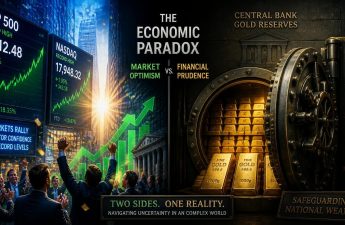
Gold is no longer only a safe place for frightened investors. It is becoming a strategic asset inside a changing world order. Central banks are buying it. Some countries are bringing it home. Regulators are watching physical flows more closely. This article argues that the new gold story is not only about price. It is about access, control, trust, and sovereignty.
There is a quiet change taking place in the world of gold. It does not always appear as a dramatic headline. There is no single global announcement saying that gold has changed its role. Yet the evidence is visible. Central banks are buying. Investors are returning. Governments are paying more attention to physical gold flows. Some countries want more of their gold at home. Others want gold transactions to become more traceable.
This does not mean that gold is disappearing from the market. It does not mean that people will suddenly be unable to buy gold everywhere. That would be too simple and, at this stage, not fully supported by verified evidence. The better interpretation is more careful: gold is moving from being only a safe haven into being a strategic asset. When an asset becomes strategic, states do not ignore it. They measure it. They classify it. They regulate it. Sometimes they try to keep it close.
For many years, gold was described with one familiar phrase: safe haven. When war came, investors bought gold. When inflation rose, people bought gold. When trust in paper money weakened, gold became the old shelter. But the present moment is different. Gold is not only shelter. It is also a signal. It tells us something about trust in the dollar system, the fear of sanctions, the fragility of reserves, and the desire of states to hold something that is nobody else’s liability.
Verified Facts: What We Know
According to the World Gold Council, total gold demand in 2025, including over-the-counter demand, exceeded 5,000 tonnes for the first time. The value of total demand reached an unprecedented 555 billion US dollars. The average annual LBMA gold price was 3,431.5 dollars per ounce, 44 percent higher than in 2024. Central banks bought 863.3 tonnes of gold in 2025. This was lower than 2024, but still historically elevated.
Investment demand also changed sharply. Total investment demand rose from 1,185.4 tonnes in 2024 to 2,175.3 tonnes in 2025. Bar and coin demand reached 1,374.1 tonnes. Gold ETFs and similar products, which had seen a small outflow in 2024, recorded 801.2 tonnes of inflows in 2025. These are not small movements. They show that both official institutions and private investors were treating gold as more than a decorative commodity.
On the supply side, the same World Gold Council data show that total supply grew only 1 percent in 2025. Mine production rose slightly to 3,671.6 tonnes. Recycled gold increased to 1,404.3 tonnes. This tells us something important. Demand can move quickly when fear rises. Supply cannot. Mines cannot be created overnight. Recycling responds to price, but even with strong price increases, it does not always flood the market.
The United States Geological Survey describes gold as both an industrial metal and a long-term store of value. It notes that gold performs important functions in computers, communications equipment, spacecraft, aircraft engines, and other products. This is often forgotten. Gold is not only a symbol. It is also a material with special physical qualities. But its unique role is still monetary. Unlike many other commodities, gold carries memory. It has been money, reserve, ornament, and insurance across centuries.
Table 1: Gold Supply and Demand, 2024–2025
| Indicator | 2024 | 2025 | Change | Interpretation |
| Total supply | 4,961.9 tonnes | 5,002.3 tonnes | +1% | Supply grew only slightly despite much higher prices. |
| Mine production | 3,650.4 tonnes | 3,671.6 tonnes | +1% | Mining supply is slow and rigid. |
| Recycled gold | 1,365.3 tonnes | 1,404.3 tonnes | +3% | Recycling rose, but not enough to transform supply. |
| Investment demand | 1,185.4 tonnes | 2,175.3 tonnes | +84% | Investor demand became the main driver of growth. |
| Bar and coin demand | 1,188.3 tonnes | 1,374.1 tonnes | +16% | Physical investment demand strengthened. |
| ETFs and similar products | -2.9 tonnes | 801.2 tonnes | Large swing | Financial gold demand returned strongly. |
| Central banks and other institutions | 1,092.4 tonnes | 863.3 tonnes | -21% | Official buying slowed but stayed historically high. |
| Average LBMA gold price | $2,386.2/oz | $3,431.5/oz | +44% | Price reflected both fear and structural demand. |
Source: World Gold Council, Gold Demand Trends: Q4 and Full Year 2025; Metals Focus; ICE Benchmark Administration.
Interpretation: Why Gold Is Becoming Strategic
A safe haven is something people run to in danger. A strategic asset is something states plan around before danger arrives. This is the difference. Gold is entering the second category.
The first reason is sanctions risk. After the freezing of Russian foreign reserves in 2022, many countries understood that reserves are not only economic instruments. They are also political instruments. A foreign bond is someone else’s promise. A bank deposit is someone else’s liability. A reserve held in another jurisdiction can become vulnerable to political decisions. Gold held directly, especially inside national borders, is different. It has no issuer. It cannot default. It does not need another government to honor it.
The second reason is monetary fragmentation. The dollar remains dominant. That is a verified fact. It is still central to trade, finance, debt, and reserves. But dominance is not the same as unquestioned trust. When countries see payment systems, sanctions, tariffs, and reserve assets used as instruments of power, they begin to search for additional doors. Gold is one of those doors. It does not replace the dollar in daily transactions. It does not pay interest. It is not easy to move in large quantities. But it offers something many states now value: political neutrality.
The third reason is domestic trust. In countries with inflation, currency weakness, or memories of financial crisis, citizens already understand gold in a simple way. They may not read central bank balance sheets. They may not follow reserve management surveys. But they know that gold feels different from paper promises. This popular memory matters. Governments know it too. When household gold demand rises sharply, it affects imports, current accounts, tax visibility, and the banking system. This is why gold regulation is never only technical. It touches trust between citizen and state.
Scenario: The New Politics of Access
The most important question may no longer be only: What is the price of gold? The deeper question is: Who can access physical gold, under what conditions, and through which system?
In Turkey, recent public discussions have focused on whether cash purchases of investment-type gold will be limited above certain thresholds and whether a Kıymetli Metal Takip Sistemi will make some gold products more traceable. Reporting by Ekonomim stated that the issue was not a complete ban on cash gold buying, but rather a limit for cash payments above 30,000 TL for investment-type products such as gram and quarter gold, while jewellery would remain outside the same scope. Yeni Şafak also reported that public confusion came from mixing the existing cash threshold with the newer tracking-system discussion.
This is not the same as confiscation. It is not proof that people will be unable to buy gold. But it is a clear sign of a wider direction: physical gold is being pulled closer to formal systems. Governments want visibility. They want to reduce informality. They want to protect tax bases, monitor flows, and manage financial stability. These aims may be understandable from a public policy perspective. But they also change the meaning of gold for citizens. A metal once valued partly because it sat outside the system is now being invited, or pushed, into the system.
Chart Ideas for the Article
| Chart | Exact data series | Source | Message |
| Chart 1: Central bank gold purchases, 2024 vs 2025 | Central banks and other institutions: 1,092.4 tonnes in 2024; 863.3 tonnes in 2025 | World Gold Council, Gold Demand Trends FY 2025 | Official buying slowed but remained historically high. |
| Chart 2: Investment demand jump | Investment demand: 1,185.4 tonnes in 2024; 2,175.3 tonnes in 2025 | World Gold Council | Private investment demand almost doubled. |
| Chart 3: Supply rigidity | Total supply: 4,961.9 tonnes in 2024; 5,002.3 tonnes in 2025; mine production: 3,650.4 to 3,671.6 tonnes | World Gold Council | Gold supply cannot quickly respond to demand shocks. |
| Chart 4: Price regime shift | Average LBMA gold price: $2,386.2/oz in 2024; $3,431.5/oz in 2025 | World Gold Council; ICE Benchmark Administration | Gold moved into a higher price regime. |
Speculation, Clearly Marked
The following is speculation, not verified fact. If geopolitical fragmentation continues, gold could become more regulated in many countries. Not necessarily banned. Not necessarily seized. But more reported, more traceable, and more closely linked to official financial channels. The future may not be a world where gold disappears. It may be a world where informal access to gold becomes narrower.
Another possible scenario is a split between paper gold and physical gold. Financial products may remain liquid, easy to trade, and globally accessible. Physical gold may carry higher premiums, stricter identification rules, or local supply bottlenecks. This would not be new in principle. During crises, physical markets often behave differently from futures markets. But the scale could become more visible if central banks, households, and institutional investors all want the same metal at the same time.
Why This Matters for Ordinary People
For an ordinary person, gold is simple. It is something you can hold. It does not need a password. It does not depend on a bank app. It does not disappear when a platform closes. That is why people trust it.
But the world around gold is no longer simple. There is mined gold, recycled gold, jewellery gold, investment bars, coins, ETFs, futures contracts, central bank reserves, and gold held in foreign vaults. These are not the same thing. A gold ETF is not the same as a coin in your hand. A central bank bar in a foreign vault is not the same as gold held inside national borders. A necklace is not the same as a standard investment bar. The word “gold” hides many different realities.
This is why public debate must be careful. Fear-based language can mislead people. Saying “gold will disappear” is too strong without evidence. Saying “nothing is changing” is also wrong. Something is changing. The change is not only in price. It is in the governance of gold.
Conclusion: The Metal Is Old, The Politics Is New
Gold has always carried power. But today that power is becoming more visible. In a world of sanctions, frozen reserves, fragile currencies, high debt, and geopolitical tension, gold is being reclassified in practice. It is still a safe haven. But it is also becoming a strategic reserve, a sovereignty instrument, and a test of trust.
The doors around gold are not fully closing. That would be an exaggeration. But they are no longer wide open in the old way. Some doors are becoming monitored. Some are becoming national. Some are becoming expensive. Some are becoming digital and traceable.
The lesson is simple. When the world trusts money less, it looks again at metal. And when states look again at metal, they rarely leave it alone.
Glossary
Safe haven: Something people buy when they are afraid. Like going under a strong roof during rain.
Strategic asset: Something important for a country’s power and safety. Like food, energy, or gold.
Central bank: The main bank of a country. It manages money and reserves.
Reserve: Savings held by a country for difficult times.
Sanctions: Punishments used by countries, often by blocking money or trade.
Counterparty risk: The risk that the person or institution owing you something may not pay or may be blocked.
ETF: A financial product traded like a stock. A gold ETF follows the price of gold, but it is not the same as holding a coin.
Physical gold: Real gold you can touch, such as coins, bars, or jewellery.
Recycled gold: Old gold melted and used again.
LBMA gold price: A widely used international reference price for gold.
Sources
- World Gold Council, Gold Demand Trends: Q4 and Full Year 2025, 29 January 2026. https://www.gold.org/goldhub/research/gold-demand-trends/gold-demand-trends-full-year-2025
- U.S. Geological Survey, Gold Statistics and Information. https://www.usgs.gov/centers/national-minerals-information-center/gold-statistics-and-information
- Ekonomim, “Kuyumculara nakit satış kısıtlaması mı getirilecek? İşte yanıtı!”, 7 January 2026. https://www.ekonomim.com/ekonomi/kuyumculara-nakit-satis-kisitlamasi-mi-getirilecek-iste-yaniti-haberi-867134
- Yeni Şafak, “Gram altında bandrol dönemi geliyor! Nakitle altın almak yasaklanacak mı?”, 8 January 2026.
- arzualvan.com articles reviewed: Parallel Sovereignty; The Quiet Architecture of a New World Order; When the Currency Changes, the World Changes; Why Gold and Silver Slept Through the Middle East Crisis.
Note: This article distinguishes verified facts, interpretation, scenarios, and speculation. It does not provide investment advice.