Japan’s Yen Defense and Russia’s Shadow Fleet as Two Faces of the Same Struggle
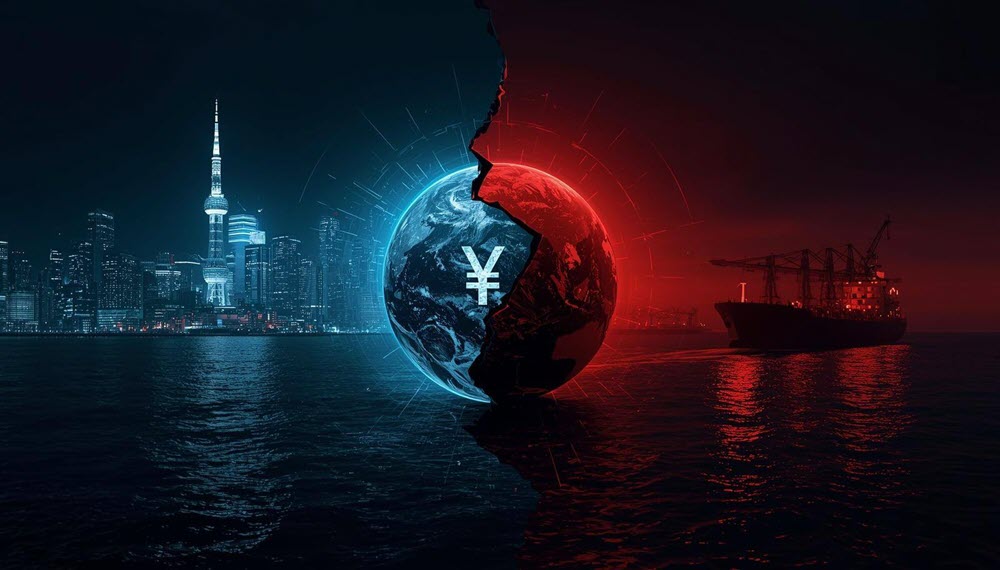
There is a strange symmetry between a central banker in Tokyo selling dollars to save the yen and a rusting tanker switching off its transponder in the Baltic Sea. One operates in the clean, digital world of foreign exchange. The other moves through fog and open water. Yet both are doing the same thing: paying a steep price to protect what their nation cannot afford to lose. This article reads Japan’s currency interventions and Russia’s shadow fleet not as isolated stories, but as two expressions of a single, emerging pattern—Parallel Sovereignty, the costly act of building alternative paths when the main road no longer serves you.
1. The Building That Still Stands
There is a strange moment when you realize that a structure you trusted has not collapsed—but has quietly stopped holding your weight.
The post-1945 global system is that building. Its pillars are familiar: dollar-denominated trade, Western-dominated maritime insurance, SWIFT-based financial messaging, and a network of rules written largely in Washington, London, and Brussels. For decades, this architecture served most participants well enough. Not perfectly. But well enough.
Now, in the spring of 2026, something has shifted. The walls have not cracked. The columns still stand. But two very different nations—one a core ally of the West, the other largely expelled from it—are quietly building their own load-bearing walls inside the same structure. They are not revolutionaries. They are not trying to tear the building down. They are simply constructing bypasses, because the main corridors have become too expensive, too dangerous, or too controlled by someone else.
Japan is defending its currency. Russia is defending its export routes. The tools are entirely different. The logic is the same.
2. Japan: The Paper Battle
Japan’s problem is precise and painful.
The U.S. Federal Reserve has held its policy rate at 3.50%–3.75%. The Bank of Japan, constrained by decades of low-growth dynamics and massive public debt, has moved far more cautiously. This gap—the interest rate differential—creates a gravitational pull. Global capital flows toward the dollar, where yields are higher. The yen weakens. And because Japan is an island nation that imports nearly all of its energy, a weak yen means expensive oil, expensive gas, and expensive everything.
In late April and early May 2026, the yen breached 160 to the dollar—a psychologically critical threshold. Japanese authorities responded. According to Bank of Japan data reported by Reuters, the intervention was estimated at approximately 5.48 trillion yen, roughly $35 billion. This followed a similar operation in July 2024 that cost around $36.8 billion [1, 2].
The mechanics are straightforward. Japan sells U.S. dollar reserves and buys yen, pushing the yen’s value back up. The yen strengthened to around 156.7 after the latest round. But the underlying forces—the rate differential, the carry trade, the energy import bill inflated by Brent crude near $109 per barrel—have not changed.
This is the quiet tragedy of Japan’s position. It is not a rebel against the system. It is one of the system’s architects. Yet the system’s current configuration—high U.S. rates, expensive energy, a strong dollar—imposes a cost that Tokyo must actively resist. Each intervention is a withdrawal from its own sovereign savings to counteract the financial weather generated by Washington’s monetary policy.
The word “intervention” sounds clinical. It is not. It is a nation spending its reserves to breathe.
3. Russia: The Physical Detour
Russia’s problem is blunter.
After 2022, Western sanctions targeted the financial and legal infrastructure that made Russian oil exportable: banking channels, insurance coverage, port access, and shipping registration. The G7 price cap attempted to keep Russian oil flowing—but only below a set ceiling, enforced through Western-dominated maritime services.
Moscow’s response was not to negotiate within these constraints. It was to build around them entirely.
The result is what analysts now call the “shadow fleet”—a sprawling armada of oil tankers operating outside Western oversight. By early 2026, estimates place its size between 600 and 800 active vessels, potentially representing around 15% of the global tanker fleet [25, 26, 36]. Over 90% of these ships are more than 15 years old. Many sail under flags of convenience from nations with minimal regulatory oversight. Their ownership is buried in layers of shell companies. They frequently switch off AIS transponders—the maritime equivalent of going dark—and conduct ship-to-ship oil transfers at sea to obscure cargo origins [27, 30].
This fleet is supported by a parallel financial layer: insurance provided by Russian state-linked entities or obscure non-Western insurers, replacing the London-based P&I Clubs that traditionally underwrite global shipping [34].
The strategy has worked—up to a point. Russia has successfully rerouted roughly 75% of its seaborne crude exports to China and India [37, 39]. But the price is significant. In January 2026, Russia’s benchmark Urals crude traded at a discount of approximately $28 per barrel compared to Brent [37]. This discount, combined with the high cost of operating aging vessels and maintaining opaque logistics, functions as a permanent tax on Russian sovereignty—the cost of staying in the game when the official rules have been rewritten against you.
4. Two Strategies, One Grammar
On the surface, these two stories share nothing. One involves a G7 ally managing exchange rates through legitimate market operations. The other involves a sanctioned state evading international restrictions through a clandestine fleet. The moral and political contexts are different.
But the structural grammar is identical.
Both nations face a system whose dominant features—U.S. monetary supremacy in Japan’s case, Western legal and financial control of maritime trade in Russia’s—impose unacceptable costs on core national interests. Both respond not by overthrowing the system, but by building parallel channels within or alongside it. And both pay a steep, ongoing price for this autonomy.
Japan’s cost is denominated in depleted reserves. Russia’s cost is denominated in discounted barrels. In both cases, the price is real, recurring, and directly measurable.
There is a deeper pattern here, one that connects to what I have written before about the quiet rerouting of global systems. China’s construction of the CIPS payment network as an alternative to SWIFT. Central banks accumulating gold at record levels—gold reached approximately $4,600 per ounce by May 2026, up over 42% year-on-year. The BRICS bloc advancing digital payment platforms to bypass dollar-denominated trade [3, 16]. None of these are revolutions. They are bypasses. They are the construction of parallel doors in a building whose main entrance is guarded by someone else.
Geography, as always, shapes the form of resistance. Japan, an island economy dependent on energy imports, fights in the currency market because the yen is its lifeline to affordable fuel. Russia, a continental energy exporter, fights in the physical world of ships and sea lanes because oil is its economic oxygen. The domain of resistance is determined by the domain of vulnerability.
5. What Could Come Next
Predictions are fragile. I hold these scenarios with appropriate humility.
Scenario A — Japan: The Slow Bleed. If U.S. rates remain elevated longer than expected, Japan faces a grinding war of attrition. Each intervention buys time but drains reserves. Political pressure on the Bank of Japan to raise rates more aggressively would intensify—a move Tokyo has tried hard to avoid, given the risks to its massive domestic debt market. This is not an acute crisis. It is a slow erosion of policy flexibility.
Scenario B — Russia: The Gray Market Hardens. The shadow fleet, currently operating in legal twilight, could gradually acquire a layer of quasi-legitimacy. Non-Western insurers and service providers—from China, India, or the UAE—might begin offering more structured coverage, narrowing the Urals discount and reducing operational risk. The consequence would be a formalized two-tier maritime system: one governed by Western rules, the other by emerging alternatives. This would not be a dramatic rupture, but a quiet bifurcation of global trade standards.
Scenario C — The Accident. The shadow fleet’s reliance on aging, poorly insured vessels creates a statistical inevitability: a major oil spill. If such an incident occurs near a sensitive coastline, the opaque ownership structures would make liability assignment nearly impossible. The cleanup costs—potentially billions—would fall on the affected nation. The political backlash could trigger a severe international crackdown, disrupting oil flows far more than the price cap ever did. This is a low-probability scenario, but a high-impact one. It is the fragility embedded in any system built on cutting corners.
6. Sovereignty Has a Price Tag
The lesson of May 2026 is not that the global system is breaking. It is that the global system is being supplemented—quietly, expensively, and from multiple directions at once.
Japan spends billions to keep its currency functional. Russia sacrifices revenue to keep its oil moving. Both are paying what might be called a sovereignty premium: the cost of maintaining national autonomy when the default infrastructure no longer serves your interests.
This is not a new phenomenon. Nations have always sought alternatives when dominant systems squeezed them. What is new is the simultaneity and diversity of these efforts. Currency markets, tanker fleets, digital payment networks, gold reserves—the bypasses are being built across every domain at once.
The building still stands. But the number of side doors is growing.
Glossary
- Carry trade: Borrowing money in a currency with low interest rates (like the yen) and investing it where rates are higher (like the dollar). This pushes the low-rate currency down.
- FX intervention: When a government buys or sells its own currency in open markets to influence its value. Japan sold dollars and bought yen to strengthen the yen.
- Shadow fleet: A large group of oil tankers operating outside Western regulatory and insurance systems, used primarily to transport sanctioned oil.
- Flags of convenience: Registering a ship in a country different from the owner’s, usually to avoid stricter regulations or taxes.
- AIS transponder: An automatic tracking system on ships that broadcasts their identity and location. Turning it off (“going dark”) hides a vessel’s movements.
- Ship-to-ship (STS) transfer: Moving cargo from one vessel to another at sea, often used to disguise the origin of oil.
- P&I Clubs: Protection and Indemnity Clubs—mutual insurance associations, mostly London-based, that cover the majority of the world’s shipping.
- Urals crude discount: The price difference between Russia’s benchmark crude oil (Urals) and the international benchmark (Brent). A wider discount means Russia earns less per barrel.
- CIPS: China’s Cross-Border Interbank Payment System, built as an alternative to SWIFT for international transactions.
- Sovereignty premium: The ongoing cost a nation pays to maintain economic or strategic independence from a dominant global system.
Sources
- “Japan may have spent $35 billion on yen-buying intervention, BOJ data shows.” Reuters, May 1, 2026.
- “Yen surges as Japan reportedly intervenes to counter currency weakness.” CNBC, April 30, 2026.
- “BRICS Advances Digital Currency Plans.” Guru / Modern Diplomacy, 2026.
- “The shadow fleet and its role in keeping Russian oil flows.” European Parliament Research Service (EPRS), 2024.
- “Russia’s Shadow Fleet: A Masterclass in Sanctions Evasion.” Geopolitical Monitor, 2026.
- “March 2026 — Monthly analysis of Russian fossil fuel exports and sanctions.” Centre for Research on Energy and Clean Air (CREA), 2026.
- “Shadow fleet of tankers keeps Russia’s oil money flowing despite Western sanctions.” Associated Press, 2025.
- “The shadow fleet is undermining the maritime order more brazenly than ever.” Atlantic Council, 2026.
- Japan Ministry of Finance — Foreign Exchange Intervention Operations data.
- IMF Article IV Consultation for Japan, 2026.