Oil, gold, war, and the quiet architecture of the next energy order
Arzu ALVAN | April 5, 2026
There is a strange clarity that arrives only after a disruption. Before the disruption, markets hum along and experts speak in probabilities. After the disruption, the same experts scramble to explain why they did not see the obvious. I have been thinking about this pattern for weeks now, watching the Strait of Hormuz transform from a quiet waterway on a shipping map into the most consequential chokepoint in modern economic history.
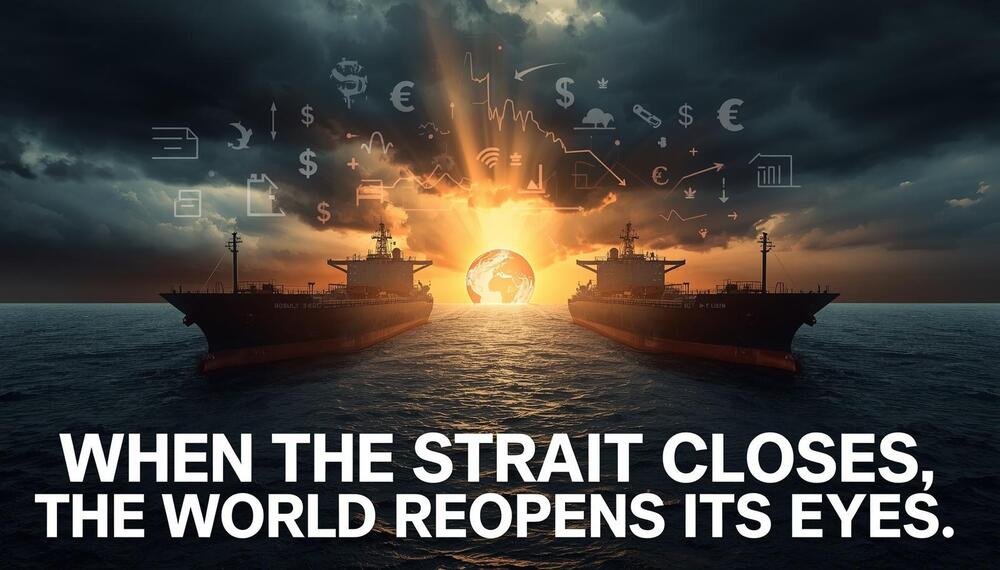
The Strait of Hormuz is barely 21 miles wide at its narrowest point. On a globe, it is almost invisible. Yet roughly 20 percent of the world’s oil supply passes through it every day. When it functions, nobody notices. When it closes, the entire architecture of global energy—pricing, insurance, futures curves, refinery margins, fertilizer costs, even the price of bread in Cairo—begins to shake. Sometimes the global economy feels like a neighborhood where the same house keeps catching fire. This time, the fire is real, and the house is the one that heats every other house on the street.
1. The War: What Happened and Where We Stand
On February 28, 2026, a combined US-Israeli air campaign began targeting Iran’s nuclear facilities, ballistic missile sites, and air defense networks. The operation was massive in scope. Within the first week, strikes expanded to include dual-use infrastructure—petrochemical plants, steel factories, logistics bridges—effectively dismantling Iran’s industrial base. By mid-March, the campaign had achieved what military planners call “strategic degradation.” Iran’s conventional military capacity was severely diminished.
But Iran did not simply absorb the blows. Tehran activated its most powerful non-nuclear weapon: geography. Iranian forces attacked commercial shipping in the Strait of Hormuz, effectively shutting down the waterway. Senior Iranian officials stated plainly that the Strait would not reopen until all attacks on Iranian territory ceased. This was not a bluff. It was leverage—the kind of leverage that does not require advanced technology, only location.
As of early April 2026, the conflict is in its sixth week. The United States has lost an F-15E and an A-10 to Iranian fire. The UAE reports intercepting 56 drones and 23 ballistic missiles in a single day. Hezbollah has intensified operations on Israel’s northern border. And President Trump, in a familiar rhetorical pattern, has declared that the war’s “strategic objectives” are “nearing completion” and could wrap up in “two to three weeks.” I have learned to treat such timelines with respectful skepticism. But the underlying signal is real: Washington wants an exit. The question is whether Tehran will offer one.
2. The Twin Chokepoint Crisis: Hormuz and Suez
The real question is not whether the Strait of Hormuz is closed. It is. The real question is whether the crisis will spread to the Bab el-Mandeb Strait—the southern gateway to the Suez Canal—and create a twin chokepoint shutdown that has no modern precedent.
Reports indicate that Iran has pressured its Houthi allies in Yemen to resume attacks on Red Sea shipping. Houthi officials have publicly threatened to close the Bab el-Mandeb if Gulf states participate in the war against Iran. The threat alone has been enough. Major carriers—Maersk, Hapag-Lloyd, CMA CGM—have once again suspended Suez transits and rerouted vessels around Africa’s Cape of Good Hope. War risk insurance premiums for Red Sea voyages have soared to approximately 1 percent of vessel value per transit, roughly $1 million for a standard $100 million ship. Before the crisis, the rate was 0.4 percent or less.
The Cape rerouting adds 10 to 14 days to an Asia-Europe voyage. That is not just a delay. It is additional fuel, additional crew wages, additional insurance, and—critically—fewer available vessels in the global fleet at any given time. Think of it in everyday terms: if every delivery truck in a city suddenly has to drive 40 percent farther for every trip, the city does not just get slower deliveries. It gets fewer deliveries. Shelves empty. Prices rise. That is what is happening to global shipping right now.
3. Oil Markets: The Anatomy of a Supply Shock
The numbers tell a story that does not require embellishment. The closure of the Strait of Hormuz removed an estimated 8 million barrels per day from global supply in March 2026. The International Energy Agency has warned that the crunch will worsen in April, with a projected shortfall of 12 million barrels per day—a figure that dwarfs every oil shock in modern history, including the 1973 Arab embargo and the 1979 Iranian Revolution. IEA Chief Fatih Birol has called it, without exaggeration, the worst energy crisis in history.
| Benchmark | Pre-War (Feb 2026) | March 2026 Peak | Change | April Forecast |
| Brent Crude (Futures) | $72/bbl | $112/bbl | +55% | $115 (Goldman Sachs) |
| WTI Crude (Futures) | $68/bbl | $99/bbl | +46% | $105–$110 est. |
| Physical Dubai Crude | $70/bbl | $140/bbl | +100% | Severe premium persists |
| Futures–Physical Spread | Negligible | $38/bbl gap | Historic | Widening |
Table 1. Oil price evolution, February–April 2026. Sources: Reuters, Goldman Sachs, IEA.
3.1 Backwardation: The Market’s Bet on Resolution
I want to draw attention to a structural feature of the oil market that often gets lost in the headline numbers: the futures curve. As of early April, the oil market is in severe backwardation. This means that near-term futures contracts trade at a significant premium over longer-dated ones. Prompt WTI settled near $99 per barrel in March, while contracts for delivery in late 2026 hovered in the mid-$70s.
What does this tell us? Backwardation is the market’s way of saying: “We believe this disruption is temporary. Supply is desperately short right now, but it will normalize.” In contrast, contango—where future prices exceed spot prices—signals oversupply or expected demand weakness. The current backwardation structure is not subtle. It is the steepest in over a decade, and it carries an implicit prediction: the war will end, the Strait will reopen, and barrels will flow again.
I share this assessment, with caveats. Based on the trajectory of the military campaign, the diplomatic signals from Washington, and the economic pressure building on all parties, I believe the active phase of this conflict will end in April 2026. The United States will declare that its strategic objectives have been met. Iran, facing severe infrastructure damage and economic isolation, will accept a ceasefire—likely brokered through Pakistani or Chinese mediation—in exchange for a halt to strikes and partial sanctions relief. The Strait of Hormuz will reopen, probably in stages, by late April or early May.
But—and this is critical—the end of the war does not mean the end of the crisis. The supply chains disrupted over these weeks will take months to normalize. The insurance markets, the shipping contracts, the refinery schedules—all of these operate on forward timelines that do not reset overnight. We put out the flames, we rebuild. But the rebuilding takes longer than the fire.
4. Beyond Oil: The Contagion Across Commodities
The energy shock is not contained within the oil market. It is spilling into every corner of the commodity complex, and the transmission channels are worth understanding.
4.1 Gold and Silver: Safe Havens Under Stress
Gold is the adult in the room. Silver is the younger sibling—more emotional, more volatile, more prone to overreaction. I have used this metaphor before, and the current crisis confirms it once again.
In the first weeks of the war, both metals surged on geopolitical fear. Gold briefly touched record highs as investors sought physical safety. But on April 3, something instructive happened: both gold and silver plummeted sharply. The reason was not a sudden outbreak of peace. The reason was inflation expectations. The oil shock forced Treasury yields higher as traders priced in the possibility that the Federal Reserve would need to keep interest rates elevated for longer. Higher real yields increase the opportunity cost of holding gold, which pays no interest. So even the “safe haven” sold off.
This is precisely the dynamic I described in my earlier work on precious metals corrections: in the initial phase of a crisis, gold rallies on fear. But if the crisis triggers persistent inflation and rising yields, the second phase punishes gold. The real question is not whether gold is a safe haven. The real question is: safe from what? Gold protects against uncertainty. It does not always protect against inflation-driven rate expectations.
4.2 Industrial Commodities and Food Security
The Gulf region is not only an oil corridor. It is a critical hub for liquefied natural gas, petrochemicals, sulfur, and nitrogen and phosphate fertilizers. The disruption of these flows threatens global food security in ways that will not appear in commodity charts for several months but will appear in grocery prices and import bills across developing nations.
| Commodity | Transmission Channel | Status (April 2026) | Risk Level |
| LNG | Hormuz transit / Gulf loading ports | Severe disruption | Critical |
| Petrochemicals | Gulf production + shipping | Major shortages | High |
| Fertilizers (N, P) | Gulf sulfur/phosphate exports | Supply delays mounting | High |
| Wheat / Grains | Energy input costs + Suez delays | Price pressure building | Moderate–High |
| Jet Fuel / Diesel | Refinery input shortage | Acute shortage (IEA) | Critical |
Table 2. Commodity contagion channels from the Hormuz–Suez twin disruption. Source: IEA, Reuters, author analysis.
5. Inflation, Growth, and the Macro Reckoning
Goldman Sachs has raised its US headline PCE inflation forecast to 3.1 percent by year-end 2026 and increased the probability of a recession to 30 percent. These are not panic numbers. They are the sober recalculation of a major investment bank adjusting its models to a world where 12 million barrels per day are missing from the supply curve.
| Indicator | Pre-War Baseline | Revised Forecast | Source |
| US PCE Inflation (YE 2026) | 2.4% | 3.1% | Goldman Sachs |
| US Recession Probability | 15% | 30% | Goldman Sachs |
| Brent Crude (2026 Avg) | $76/bbl | $115/bbl (April) | Goldman Sachs |
| Global Oil Supply Gap | Balanced | −12 million bpd (April) | IEA |
| Suez Canal Traffic | Recovering | −60% vs. normal | Suez Canal Authority |
Table 3. Macroeconomic impact dashboard, April 2026. Sources: Goldman Sachs, IEA, Suez Canal Authority.
The inflation channel works through multiple layers. The first layer is direct: oil and gas prices feed into transportation, heating, and electricity costs. The second layer is indirect: fertilizer disruptions raise food prices with a lag of three to six months. The third layer is psychological: once businesses and consumers expect higher prices, they adjust behavior—demanding higher wages, front-loading purchases, hoarding inventory—in ways that make the inflation self-reinforcing. Central bankers call this “unanchored expectations.” I call it the moment when the thermometer stops measuring the fever and starts causing it.
For the Federal Reserve, this creates an impossible dilemma. Cut rates to support growth, and you risk accelerating inflation. Hold rates steady, and you risk tipping the economy into recession while energy costs squeeze household budgets. There is no clean answer. There is only the least bad option, chosen under uncertainty. This is why I watch the Fed’s language as carefully as I watch the futures curve. Both are trying to price a future they cannot see.
6. The Endgame: Why I Expect Resolution in April
Let me be transparent about my reasoning. Predictions are fragile, and I hold this one with appropriate humility. But the evidence points toward a cessation of major hostilities within April 2026, for three reasons.
First, military logic. The US-Israeli campaign has achieved its primary objectives: Iran’s nuclear program has been set back significantly, its ballistic missile infrastructure is degraded, and its conventional military capacity is diminished. Continued strikes face diminishing returns and increasing risk of escalation—particularly as Iran has demonstrated the ability to strike Gulf states housing US forces.
Second, economic pressure. Oil above $100 is politically toxic in Washington. Every week the Strait remains closed, the US consumer pays more at the pump, the inflation narrative worsens, and the probability of recession rises. The same administration that launched the war needs the war to end before its economic consequences become electorally catastrophic.
Third, diplomatic channels. Despite the public posturing—Iran denying any negotiations, the US claiming Iran requested a ceasefire—the back-channel infrastructure exists. Pakistan has emerged as a broker. China has proposed a five-point peace plan. Even Egypt, whose Suez Canal revenue is collapsing, is pressuring all sides toward resolution. The diplomatic dead end is real, but it is also temporary. When both sides need an exit, they find one.
The most likely scenario, in my assessment, is a phased de-escalation: the US declares its objectives met, strikes wind down, and Iran begins reopening the Strait in stages. This will not happen cleanly. There will be setbacks, violations, and mistrust. But the structural incentives point toward April as the turning point.
7. Key Concepts: A Brief Glossary
Backwardation: A futures market structure in which near-term contracts trade at a premium to longer-dated contracts. In oil markets, it signals tight current supply and an expectation that the shortage is temporary.
Contango: The opposite of backwardation: future prices exceed spot prices. This typically indicates oversupply or weak near-term demand. Storage costs contribute to the contango structure.
Chokepoint: A narrow geographic passage through which a disproportionate share of global trade flows. The Strait of Hormuz (oil) and the Bab el-Mandeb/Suez Canal (goods) are the two most critical maritime chokepoints.
PCE Inflation: Personal Consumption Expenditures price index. The Federal Reserve’s preferred measure of inflation, as it captures a broader basket of goods and services than the more commonly cited CPI.
War Risk Premium: An additional insurance charge levied on vessels transiting conflict zones. Typically expressed as a percentage of the vessel’s insured value per voyage.
Real Yield: The return on a bond after subtracting inflation. When real yields rise, non-yielding assets like gold become relatively less attractive.
8. Final Reflections
I began this piece with the observation that clarity often arrives only after disruption. That is true, but it is also incomplete. The deeper truth is that the clarity was always available—in the data, in the geography, in the historical patterns. The Strait of Hormuz has been a vulnerability for decades. The Suez Canal rerouting crisis of 2023–2025 was a rehearsal. The fragility of just-in-time supply chains has been documented in every post-pandemic report. We knew. We just chose not to price it.
Global crises do not always invent new plots. Very often they reuse the same plot and just change the costume. This crisis is wearing a new costume—a US-Israeli campaign against Iran rather than an Arab embargo or an Iraqi invasion—but the underlying plot is the same: the world’s dependence on a narrow corridor of water, the assumption that it will always be open, and the shock when it is not.
I expect this war to end soon. I expect the Strait to reopen. I expect oil prices to decline from their current extremes. But I do not expect the vulnerability to disappear. The next crisis will arrive, as it always does, at the same chokepoint, wearing a different costume. The only question is whether we will be better prepared—or whether we will, once again, wait for the disruption to deliver the clarity we should have had all along.
The spread between futures and physical prices is simply the market’s way of pricing this vulnerability—and right now, that price is very high indeed.
Disclaimer: This text is for informational and educational purposes only. It is not investment advice. The analysis reflects the author’s interpretation of publicly available data and should not be used as the sole basis for any financial decision.
References & Data Sources
[1] International Energy Agency (IEA), “Oil Market Report – April 2026,” iea.org.
[2] Goldman Sachs, “Oil Price Forecast Update: Hormuz Disruption Scenario,” March 31, 2026.
[3] Reuters, “Iran war shock drives steepest hike yet in oil price forecasts,” March 31, 2026.
[4] Reuters, “Oil prices drop on hopes of US pullback in Iran war,” April 2, 2026.
[5] CNBC, “Oil supply crunch will worsen in April, IEA warns,” April 1, 2026.
[6] Institute for the Study of War (ISW), “Iran Update Special Report,” April 1–4, 2026. understandingwar.org.
[7] Al Jazeera, “Iran war: What is happening on day 35 of US-Israeli attacks?” April 3, 2026.
[8] Goldman Sachs, “US Economic Outlook: Recession probability revised to 30%,” March 25, 2026.
[9] gCaptain, “Suez Canal Traffic Stalls at 60% Below Normal,” gcaptain.com.
[10] Suez Canal Authority, Traffic and Revenue Reports, 2026.
[11] World Gold Council, “Gold Outlook 2026,” gold.org.
[12] CNBC, “Oil prices surge as Yemen’s Houthis attack Israel,” March 30, 2026.
[13] House of Commons Library, “US/Israel-Iran Conflict 2026,” commonslibrary.parliament.uk.
[14] CFR Global Conflict Tracker, “Iran’s War With Israel and the United States,” cfr.org.
[15] Beinsure, “Insurance costs for Red Sea shipping soar amid renewed Houthi attacks,” beinsure.com.