When we talk about AI today, we should talk about energy. How much power do we use to train models, and how much to serve them every day? How this demand shifts the world energy balance? And can we design a cleaner path? These are not simple questions. But we can put numbers. And we can design better systems.
I bring engineering and policy together. I look at training and inference, hardware efficiency, data centre design, regional differences, and regulation. I write simple; short sentences. Sometimes I ask a question. Because the reader should think with me.
Energy measurement and facility metrics
AI systems have two energy faces: training and inference. Training is intense but not frequent. Inference is lighter per request but continuous. For large deployments, inference often dominates lifecycle energy (Patterson et al., 2021; Joule, 2023).
In data centres, PUE (Power Usage Effectiveness) is the basic facility metric: total facility energy divided by IT energy (The Green Grid). Global average PUE stayed near 1.55–1.60 in recent years, while hyperscalers report ~1.1–1.2 in their most efficient sites (Uptime Institute, 2024). Liquid and immersion cooling reduce cooling energy and can lower PUE, but PUE is not carbon. For carbon, we also watch the grid mix and use complementary metrics like CUE (Carbon Usage Effectiveness) and WUE (Water Usage Effectiveness). DCeP looks at useful work per unit energy. Figure 3 shows the global PUE trend.
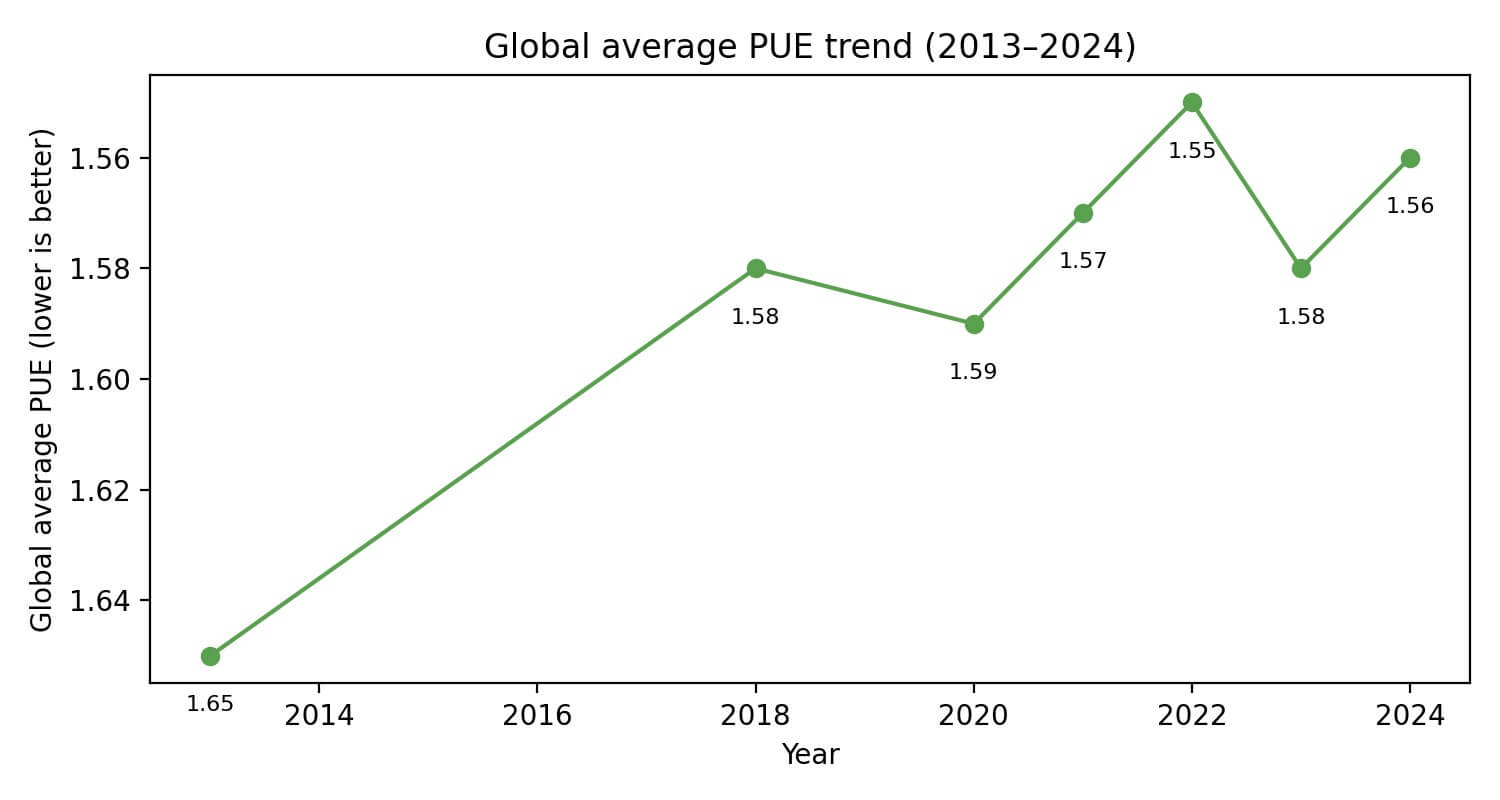
Figure 3. Global average PUE trend (2013–2024). Sources: Uptime Institute Global Data Center Survey; compiled values (Statista).
Global impact and regional trends
IEA estimates that data centres, AI and crypto together used about 460 TWh in 2022. By 2026, demand could reach 620–1,050 TWh (Electricity 2024). The base case is near the middle of that range. The uncertainty is real; it depends on AI adoption, efficiency, and policy. For 2030, multiple scenarios exist. In my figures, I show 2030 as an illustrative bar to discuss drivers, not a fixed forecast.
Region matters. The US and China drive much of the growth; the EU grows too but faces grid constraints in places like Ireland and the Netherlands. Figure 1 shows the IEA points and range. Figure 2 shows indicative regional values and a 2030 projection, with sources noted in the references.

Figure 1. Electricity use from data centres, AI and crypto: 2022 actual and IEA projection range to 2026 (base case shown); 2030 is an illustrative scenario. Source: IEA Electricity 2024; IEA Energy & AI (2025).
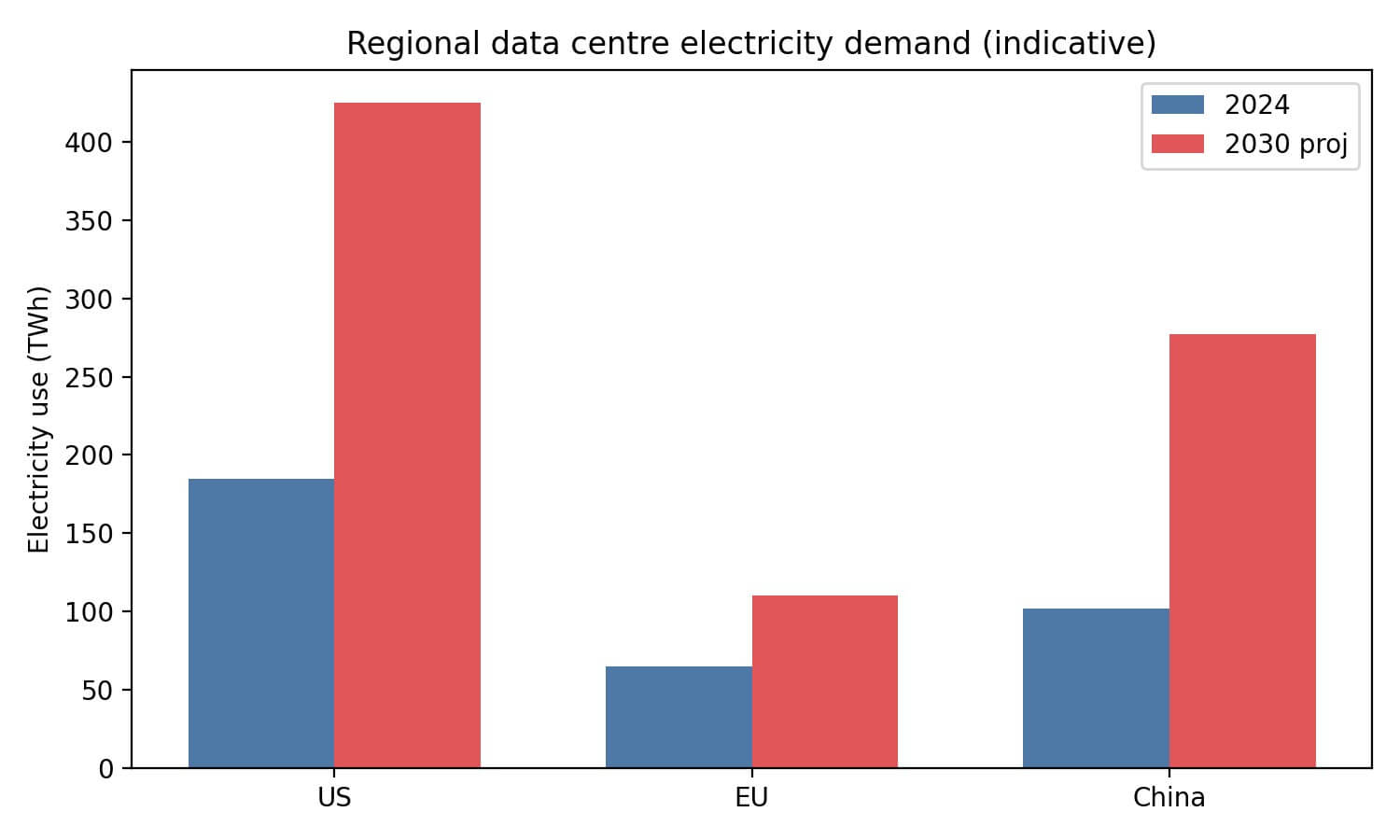
Figure 2. Regional data centre electricity demand (indicative) for 2024 and 2030. Sources: IEA 2024/2025 analyses referenced in the text.
Hardware efficiency: GPUs, TPUs, and ASICs
Hardware shapes energy. NVIDIA H100 class accelerators (SXM) target ~700 W TDP; newer parts approach ~1 kW with liquid cooling. AMD MI300X expands HBM capacity at ~750 W TDP. Google TPU v5 families emphasize perf/W, particularly for inference. MLPerf (MLCommons) shows strong throughput across these devices under standard tasks (e.g., BERT, ResNet, LLMs); some submissions also include wall-power measurements (MLCommons, 2024). Always read MLPerf disclosures and vendor datasheets for exact test conditions.
Algorithmic efficiency is critical. Quantization (INT8/INT4) reduces memory and energy while keeping accuracy close (Dettmers et al., 2022; 2023). Knowledge distillation compresses a teacher into a smaller student (Hinton et al., 2015). Mixture-of-Experts activates only part of the model per token (Fedus et al., 2021; Mixtral, 2024). FlashAttention reduces memory traffic and speeds attention (Dao et al., 2022). Compute-optimal scaling (Hoffmann et al., 2022) shows that right-sized models trained on more tokens can be both cheaper and better.
Carbon, renewables, and the case of Türkiye
Türkiye’s electricity mix is in transition. In recent years, coal remained near the mid–30% share; hydro close to one‑fifth; wind about 10–11%; solar above 5% and rising; geothermal/biomass ~3–5%. Ember’s Türkiye reviews indicate that imported coal is a large component of coal generation, while wind and solar provided most of demand growth since 2019 (Ember, 2024–2025; TEİAŞ monthly reports).
For AI infrastructure in Türkiye, direct procurement of new solar and wind via PPAs — coupled with battery storage — can reduce marginal emissions and improve resilience. Hourly matching (24/7 CFE) is more robust than annual matching for real carbon impact.
| Source (Türkiye) | Indicative share (most recent years) |
| Coal (incl. imported) | ≈ 35–36% (imported coal significant) |
| Natural gas | ≈ 18–30% (variable by year) |
| Hydro | ≈ 20–22% (weather dependent) |
| Wind | ≈ 10–11% |
| Solar | ≈ 6–8% and rising |
| Geothermal + biomass | ≈ 3–5% |
Table 2. Türkiye electricity generation mix (indicative). Sources: TEİAŞ; Ember Türkiye Electricity Reviews (2024–2025).
Policy and strategy: EU, US, and selected countries
Policy is moving. In the EU, the recast Energy Efficiency Directive (Directive (EU) 2023/1791) requires data centres with IT load ≥500 kW to report metrics (PUE, temperatures, energy reuse, renewable share) annually into an EU database (operated by the JRC), with first reporting in 2025 for 2024 data. The EU Code of Conduct for Data Centres provides best practices. Under CSRD, many firms will disclose energy and emissions with more detail.
Ireland placed strict connection criteria in constrained zones — location, on‑site dispatchable generation/storage, and demand flexibility — effectively limiting new Dublin‑area connections until grid reinforcements arrive. The Netherlands restricted hyperscale sites nationally in 2022, with designated areas and strong requirements on efficiency, heat reuse, and renewable sourcing. In the US, DOE and Energy Star programs guide efficiency while corporate PPAs drive clean supply.
Practical efficiency playbook
A pragmatic recipe to cut energy without losing capability:
1) Right‑size models; prefer distilled/smaller models when the task allows.
2) Use quantization by default (INT8); test INT4 where safe.
3) Prefer MoE for large‑context tasks; route only needed experts.
4) Push compute to the edge when privacy/latency helps and power is already provisioned.
5) Apply caching and retrieval to reduce repeated generation.
6) Optimize data pipelines; IO can be a hidden energy sink.
7) Track real metrics: energy per 1,000 tokens; energy per training step; carbon per query (hourly).
Corporate 24/7 CFE and heat reuse
Google targets 24/7 carbon‑free energy by 2030 and reports high hourly CFE in several regions. Microsoft targets carbon negative by 2030, with 100% renewable procurement and pilots for firm clean power. Amazon remains the largest corporate buyer of renewables globally. Some sites reuse waste heat (e.g., Google Hamina, Finland; Microsoft Sweden), showing how AI infrastructure can support local energy systems (corporate sustainability reports, 2023–2024).
Conclusion: 2025–2035 outlook
We will see three forces together: (i) better hardware with higher absolute power but more performance, (ii) better algorithms that reduce compute for the same quality, and (iii) grids with more renewables and storage. The balance depends on demand. If we use the biggest models for every task, energy may outpace efficiency. If we right‑size models, colocate renewables, and recycle heat, AI can help accelerate clean grids rather than stress them. The choice is ours.
References (APA)
International Energy Agency. (2024). Electricity 2024: Analysis and forecast to 2026. https://iea.blob.core.windows.net/assets/18f3ed24-4b26-4c83-a3d2-8a1be51c8cc8/Electricity2024-Analysisandforecastto2026.pdf
International Energy Agency. (2025). Energy and AI. https://iea.blob.core.windows.net/assets/601eaec9-ba91-4623-819b-4ded331ec9e8/EnergyandAI.pdf
Uptime Institute. (2024). Global Data Center Survey. https://uptimeinstitute.com/
The Green Grid. (n.d.). Data center metrics (PUE/WUE/CUE/DCeP). https://www.thegreengrid.org/
Dettmers, T., Lewis, M., Shleifer, S., & Zettlemoyer, L. (2022). LLM.int8(): 8-bit matrix multiplication for transformers at scale. arXiv. https://arxiv.org/abs/2208.07339
Dettmers, T., Pagnoni, A., Holtzman, A., et al. (2023). QLoRA: Efficient finetuning of quantized LLMs. arXiv. https://arxiv.org/abs/2305.14314
Fedus, W., Zoph, B., & Shazeer, N. (2021). Switch transformers: Scaling to trillion parameter models with simple and efficient sparsity. arXiv. https://arxiv.org/abs/2101.03961
Dao, T., Fu, D., Ermon, S., Rudra, A., & Re, C. (2022). FlashAttention: Fast and memory-efficient exact attention with IO-awareness. arXiv. https://arxiv.org/abs/2205.14135
Hoffmann, J., Borgeaud, S., Mensch, A., et al. (2022). Training compute-optimal large language models. arXiv. https://arxiv.org/abs/2203.15556
Patterson, D., Gonzalez, J., Le, Q., et al. (2021). The carbon footprint of machine learning training will plateau, then shrink. Google Research Blog. https://research.google/blog/good-news-about-the-carbon-footprint-of-machine-learning-training/
MLCommons. (2024). MLPerf Inference v4.1 results. https://mlcommons.org/2024/08/mlperf-inference-v4-1-results/
Ember. (2025). Türkiye Electricity Review 2025. https://ember-energy.org/app/uploads/2025/03/Turkiye-Electricity-Review-2025_11032025.pdf
Türkiye Elektrik İletim A.Ş. (TEİAŞ). (n.d.). Aylık elektrik üretim/tüketim raporları. https://www.teias.gov.tr/tr-TR/aylik-elektrik-uretim-tuketim-raporlari
European Commission. (2023). Directive (EU) 2023/1791 (Energy Efficiency Directive, recast). https://eur-lex.europa.eu/legal-content/EN/TXT/?uri=CELEX:32023L1791
Commission for Regulation of Utilities (CRU). (n.d.). Data centre connection policy. https://www.cru.ie/
Government of the Netherlands. (2022). Cabinet tightens rules for hyperscale data centres. https://www.rijksoverheid.nl/actueel/nieuws/2022/02/16/kabinet-besluit-tot-aanscherping-regels-hyperscale-datacenters
Google. (2024). 24/7 Carbon-Free Energy and clean energy PPAs. https://cloud.google.com/sustainability/region-carbon
Microsoft. (2024). Sustainability commitments and data centre heat reuse. https://www.microsoft.com/en-us/sustainability
Amazon. (2024). Renewable energy investments. https://sustainability.aboutamazon.com/
Leave a Reply